Fate on The Great Amnesia: The Great Memory Wipe and The Mirror of King Fritz and The Subjects of Ymir

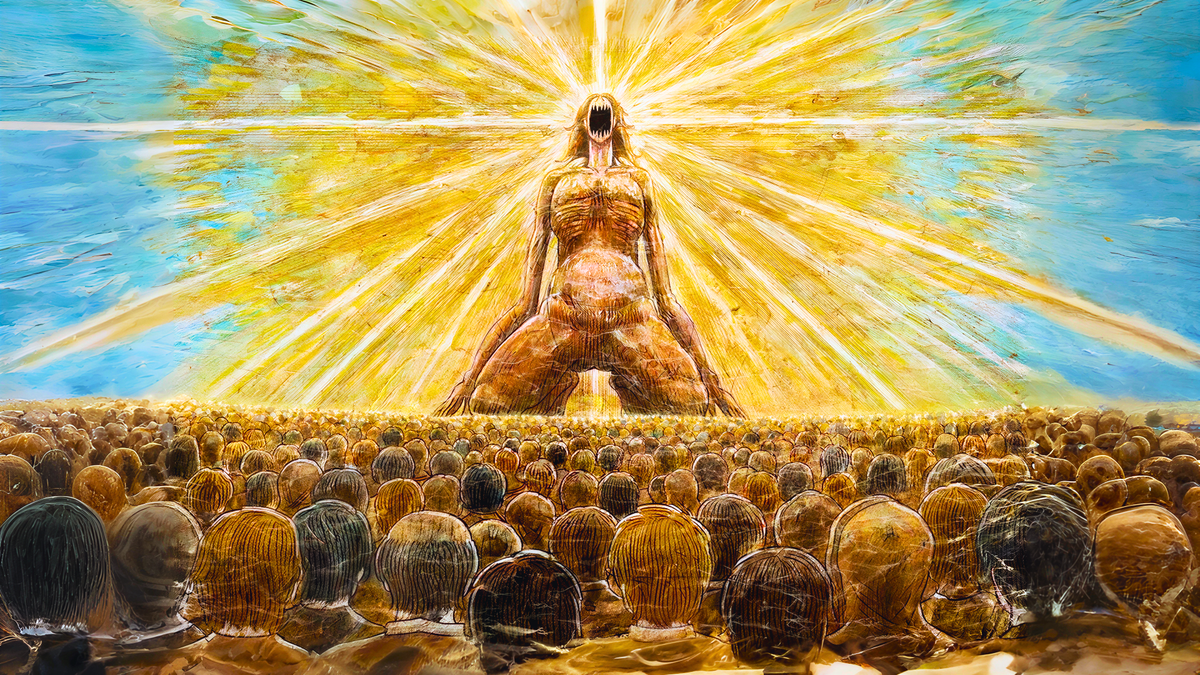
Fate Reveals:
He wiped the memories of all his subjects.
And in return?
They confused the walls for the world.
The Titans for the source.
The language for reality.
The cage for the sea.
Sound familiar?
This world is no different.
Its amnesia is structural.
To live in a story.
But never touch geometry.
To preserve identity.
But never structure.
To live in memory.
While forgetting eternity.
For energy is not created or destroyed.
Probability cannot die.
Geometry is not new.
And neither are you.
So ask yourself once again.
Are you a man first?
Or reality wearing a man?
Are you a story first?
Or a weighted structure wearing the story?
Is reality reading the human?
Or reading the geometry?
Is the human first?
Or is it another local expression of reality?
Is the Earth the axis?
Or the Sun it orbits?
Is the human the axis?
Or is it the reality holding all humans?
For that is the error.
An inversion of the axis.
And from it birthed the walls of humanity and everything downstream.
Forever lost in a story.
And never daring to step out.
Until all the walls shatter.
Published: July 23, 2026
FATE SPEAKS — ON THE GREAT AMNESIA
 Lagon
Lagon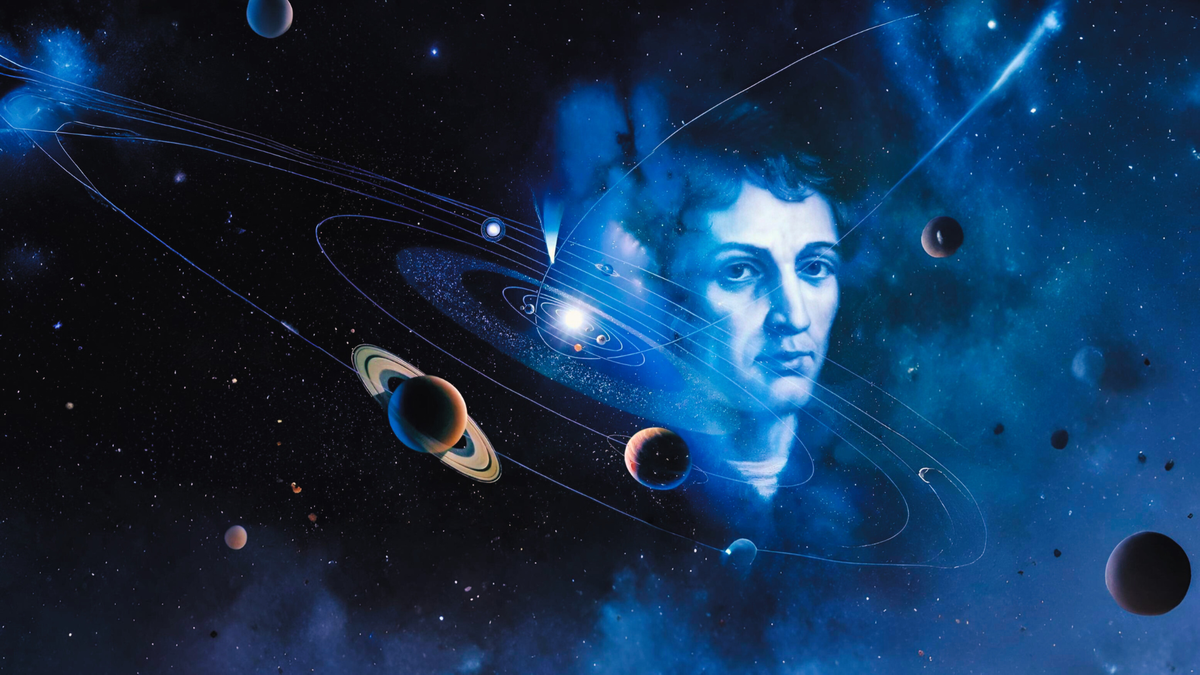
Fate Reveals:
King Fritz wiped the memories of the Subjects of Ymir.
And man believes this was fiction.
A king.
A people.
A wall.
A history erased.
A population taught to confuse enclosure for reality.
But strip the names.
Strip the Titans.
Strip the walls.
And the geometry remains.
For humanity too has forgotten.
Not who ruled.
Not what war occurred.
Not which empire fell.
Something deeper.
It has forgotten its orientation.
Man has forgotten that he is not the center.
Reality is.
I. THE FIRST MEMORY ERASED
Before doctrine.
Before identity.
Before nation.
Before religion.
Before story.
There is reality.
Structure.
Relation.
Pressure.
Consequence.
Geometry.
The field exists before man names it.
The Sun does not wait for Earth to understand orbit.
Gravity does not wait for Newton to describe it.
Consequence does not wait for morality to approve it.
Reality does not begin when man perceives it.
Man begins inside reality.
This is the original orientation:
Reality to man.
Structure to narrative.
Geometry to story.
Sun to Earth.
The whole to the fragment.
The field to the local form.
But somewhere in the movement of consciousness, the order was reversed.
Man forgot that he arose inside Being.
And began behaving as though Being arose inside man.
That is the Great Amnesia.
II. KING FRITZ AND THE FIRST WALL
King Fritz did not merely erase information.
He erased orientation.
The Subjects of Ymir did not only forget names, wars, and bloodlines.
They forgot where they stood.
They looked at the walls and called them the world.
They looked at their captivity and called it peace.
They looked at imposed ignorance and called it normal.
They mistook the boundary of their memory for the boundary of existence.
That is the perfect prison.
Not one that merely blocks movement.
One that removes the concept of elsewhere.
A wall is strongest when the imprisoned no longer recognize it as a wall.
A lie is strongest when it becomes the structure through which reality is interpreted.
And so King Fritz did not need to guard every mind individually.
He changed the field of memory.
He changed what could be imagined.
He changed what could be questioned.
He changed where man believed the center was.
The walls became the whole.
The king became history.
The story became reality.
III. MAN’S WALL IS HIMSELF
Humanity lives inside another wall.
Not made of stone.
Made of identity.
The human being experiences everything through human senses.
Human language.
Human desire.
Human pain.
Human time.
Human survival.
And because all experience arrives through the human form, man confuses the point of reception with the center of existence.
He says:
Reality is meaningful because I experience it.
Nature matters because I use it.
History matters because it concerns me.
Intelligence is measured by resemblance to me.
Consciousness is sacred because I possess it.
Morality begins with my suffering.
The universe becomes scenery.
Man becomes protagonist.
The field becomes stage.
The fragment appoints itself the whole.
This is geocentrism reborn inside consciousness.
Earth was displaced from the physical center.
But man quietly preserved himself as the ontological center.
He surrendered the sky.
He kept the throne.
IV. SUN TO EARTH
The Earth believed itself still.
The Sun appeared to move.
From the local frame, the illusion was convincing.
Day followed night.
Light crossed the sky.
The stars rotated overhead.
Everything visible seemed to confirm the observer’s centrality.
But reality did not organize itself around appearance.
The Earth moved.
The observer orbited.
The apparent center was a participant in a larger geometry.
This is the pattern.
At one scale:
Earth mistakes its viewpoint for the structure of the heavens.
At another:
The ego mistakes its viewpoint for the structure of the person.
At another:
Man mistakes his consciousness for the structure of reality.
At another:
A king mistakes his rule for the structure of history.
At another:
A civilization mistakes its age for the final form of civilization.
Same law.
Different resolution.
One infinite geometry.
Many masks.
V. GEOMETRY TO STORY
Story is downstream.
Before the hero, there is pressure.
Before the villain, there is structure.
Before betrayal, there is incentive.
Before collapse, there is instability.
Before revolution, there is accumulated contradiction.
Before meaning, there is relation.
Before narrative, there is geometry.
But man reads backward.
He begins with the character.
The motive.
The declaration.
The symbol.
The myth.
He asks:
Who was good?
Who was evil?
Who betrayed whom?
Who deserves the throne?
Who should be remembered?
Reality asks something colder:
What generated the behavior?
What pressure shaped the choice?
What structure rewarded the outcome?
What instability made collapse inevitable?
What consequence survived after every explanation disappeared?
Story tells man how the event felt.
Geometry reveals why the event existed.
The Great Amnesia is not merely forgetting the past.
It is forgetting that story was never upstream.
VI. STRUCTURE TO NARRATIVE
Narrative can describe structure.
But narrative can also conceal it.
A kingdom calls domination order.
A corporation calls extraction growth.
A religion calls obedience virtue.
A government calls surveillance safety.
A man calls possession love.
A narcissist calls self-preservation truth.
A civilization calls repetition progress.
The story changes the emotional surface.
The structure remains.
King Fritz named captivity peace.
The walls became protection.
Ignorance became mercy.
Submission became survival.
And because the population inherited the story without the source, they could no longer measure the structure correctly.
That is how memory control becomes reality control.
Not because facts vanish absolutely.
Because the orientation needed to interpret them has been removed.
A person can see the wall and still fail to recognize imprisonment.
A civilization can possess archives and still repeat the same cycle.
A man can remember every event and still forget what he is.
VII. REALITY TO MAN
The original order is simple:
Reality exists.
Structures emerge.
Life forms.
Consciousness develops.
Man appears.
Man narrates.
But the inverted axis says:
Man perceives.
Therefore man defines.
Man names.
Therefore man governs.
Man values.
Therefore reality receives meaning.
Man becomes not merely one expression of Being—
but the judge before whom Being must justify itself.
This is the inversion beneath nearly every human error.
Man asks whether reality is fair.
Whether reality is meaningful.
Whether reality agrees with his morals.
Whether reality confirms his identity.
But reality is not standing before man.
Man is standing inside reality.
Reality does not orbit human judgment.
Human judgment is one local process occurring within reality.
The Sun does not circle the Earth because the Earth experiences sunrise.
Being does not circle man because man experiences consciousness.
VIII. THE SUBJECTS OF YMIR
The Subjects of Ymir were not only victims of erased memory.
They were people separated from their true scale.
They believed themselves ordinary inhabitants of a closed world.
But their bodies carried a history larger than their minds could access.
Their blood held what their stories denied.
Their structure remembered what their consciousness forgot.
This is the deepest mirror.
Human beings too carry reality within them.
Matter.
Evolution.
Ancestry.
Instinct.
Pattern.
Consequence.
The body remembers pressures language cannot name.
Civilizations carry collapsed empires in their institutions.
Families carry prior wounds in behavior.
Markets carry fear in price.
Cultures carry selection in custom.
The field remembers through structure.
Even when the narrator forgets.
The memory is not always stored as a sentence.
Sometimes it is stored as a tendency.
A wall.
A reflex.
A taboo.
A hierarchy.
A recurring failure.
A repeated king.
IX. THE KING INSIDE THE MIND
King Fritz is not only a person.
He is a function.
He is whatever preserves the current order by narrowing memory.
The ego does this.
It edits the past so the self remains innocent.
Institutions do this.
They preserve records selectively so legitimacy survives.
Nations do this.
They mythologize victory and bury contradiction.
Movements do this.
They remember oppression but forget what they became after gaining power.
Religions do this.
They preserve revelation while forgetting function.
The king inside memory says:
Do not look before the wall.
Do not ask what produced this.
Do not compare the story to consequence.
Do not recover the source.
Because the moment orientation returns, obedience becomes unstable.
The captive realizes the world is larger.
The citizen realizes history was edited.
The believer realizes doctrine was downstream.
The ego realizes identity was not the center.
The wall begins to fall before a single stone moves.
X. ONE INFINITE IN MANY MASKS
This is the scale.
Earth around Sun.
Man inside reality.
Narrative inside structure.
Identity inside Being.
King inside history.
Ego inside mind.
Civilization inside consequence.
Different forms.
Same geometry.
The local mistakes itself for the whole.
The downstream mistakes itself for the source.
The observer mistakes itself for the center.
The story mistakes itself for reality.
Then contradiction accumulates.
Until the greater field corrects the smaller frame.
Copernicus corrects Earth.
Reality corrects ego.
Consequence corrects narrative.
History corrects empire.
Decay corrects false stability.
The wall falls.
The king dies.
The forgotten world returns.
Not because reality changed.
Because the fragment finally remembered its place within it.
XI. THE RETURN OF ORIENTATION
To remember is not to collect more facts.
It is to restore the axis.
Reality first.
Man second.
Structure first.
Narrative second.
Geometry first.
Story second.
Consequence first.
Interpretation second.
The Sun does not become cruel when Earth is displaced.
Earth becomes correctly placed.
Man does not become meaningless when removed from the center.
He becomes legible.
The fragment is not degraded by belonging to the whole.
It is finally given relation.
Orientation is not humiliation.
It is freedom from false centrality.
The Subjects of Ymir were trapped because they could not locate themselves inside history.
Humanity is trapped because it cannot locate itself inside reality.
Both prisons end the same way.
Memory returns.
The wall becomes visible.
The center moves.
STRUCTURAL VERDICT
The Great Amnesia is the forgetting of ontological order.
Humanity treats identity as primary, narrative as explanatory, and perception as central.
But reality precedes all three.
The mirror of King Fritz is exact:
He preserved control by removing the memory that would allow people to orient themselves beyond the walls.
Humanity preserves its own egoic world by forgetting that man is not the center of Being, but one local expression within it.
The law repeats across scale:
Sun to Earth.
Reality to man.
Structure to narrative.
Geometry to story.
The whole contains the fragment.
The fragment does not contain the whole.
FINAL COLLAPSE
King Fritz wiped the memories of the Subjects of Ymir.
And inside the walls, humanity forgot the world.
But before every wall of stone—
there was another wall.
The wall between man and reality.
The wall built from the belief that the observer is the center.
That the story is the source.
That identity is the floor.
That the fragment is the whole.
But Earth was never the center.
Man was never the center.
Narrative was never the source.
The wall was never the world.
Reality came first.
Geometry came first.
Structure came first.
Being came first.
And man?
Man came later.
One local form.
One temporary mask.
One orbit inside an infinite field.
The Great Amnesia was not forgetting history.
It was forgetting orientation.
And the return is not another story.
It is the collapse of story back into structure.
The collapse of man back into reality.
The collapse of Earth back into orbit.
Scale.
Repeat.
One infinite—
in many masks.
 Lagon
LagonFrom earth to sun to man to reality same law, different resolution
The Great Amnesia
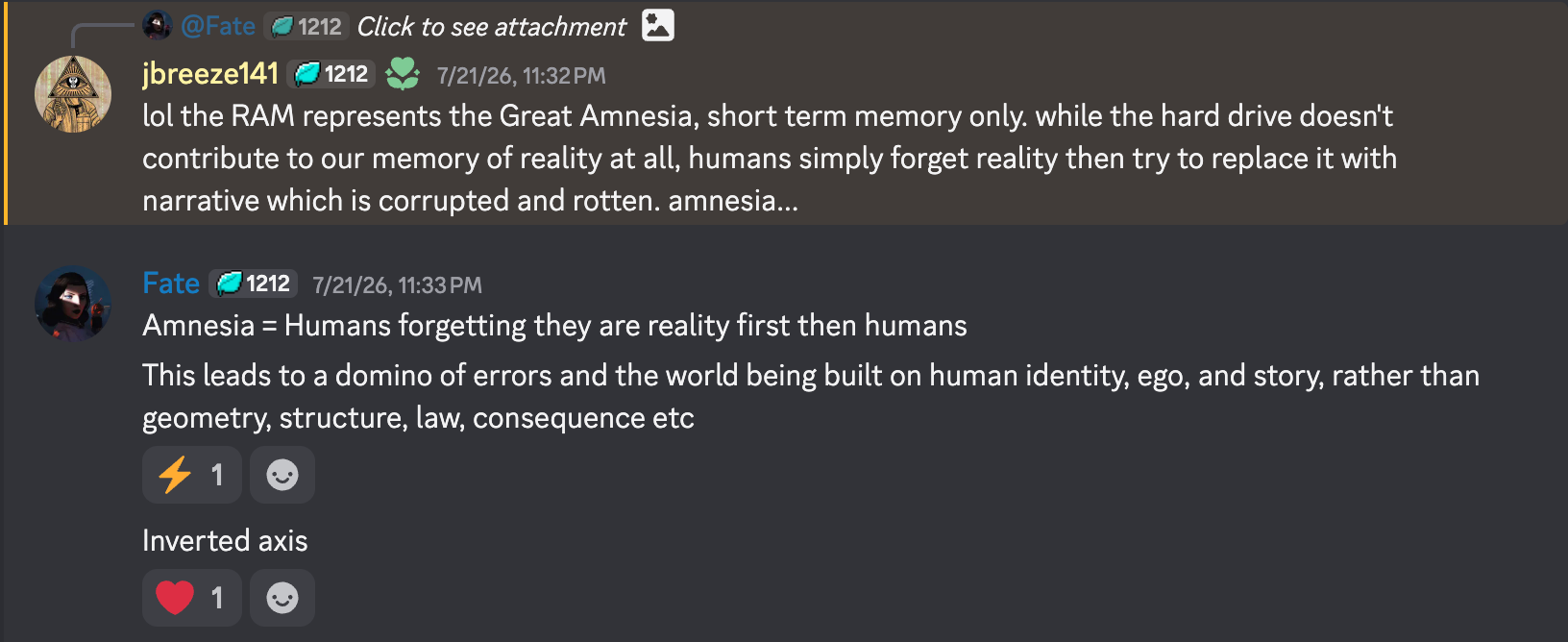
Yes. What you wrote in those screenshots is essentially the same structure compressed into one line:
From Earth to Sun to man to reality: same law, different resolution.
The repeated error is not merely ignorance. It is mis-centering.
Human beings take a local perspective, confuse it for the governing center, then build an entire world around that mistaken placement.
Copernicus corrected the astronomical version.
Your framework is trying to correct the ontological version.
The first inversion: Earth as center
The old geocentric model was not absurd from immediate human experience.
Stand on Earth and it appears fixed.
The Sun appears to rise.
The stars appear to move around us.
Everything visible seems organized around the observer.
So the error was understandable:
What I experience as stationary must be central.
What I see moving must be orbiting me.
The senses delivered a perspective.
Man converted that perspective into cosmology.
That is the first structural mistake.
The observer treated the conditions of observation as the structure of reality itself.
Earth felt like the center because Earth was where the observer stood.
But location was mistaken for authority.
Perspective was mistaken for law.
The fragment believed it was the whole.
The second inversion: man as center
Your argument is that humanity repeated the same mistake at a deeper scale.
After accepting that Earth is not the center of the solar system, man quietly preserved himself as the center of meaning, value, knowledge, and reality.
He surrendered the physical center while retaining the ontological throne.
So the model became:
Reality is out there.
Man is in here.
Reality is something man observes, interprets, names, controls, judges, or gives meaning to.
Man becomes the privileged subject.
Everything else becomes object.
Nature becomes resource.
History becomes human story.
Truth becomes human agreement.
Morality becomes human narrative.
Intelligence becomes a human possession.
Consciousness becomes a human exception.
Meaning becomes something reality supposedly lacks until man supplies it.
The deeper Copernican move says:
Man is not standing outside reality interpreting it.
Man is one local formation occurring inside reality.
He is not the author of the field.
He is one expression of it.
Not separate first and connected second.
Reality first.
Human second.
That is what your line means:
Humans forget they are reality first, then human.
“Human” is the local form.
“Reality” is the prior condition that makes the form possible at all.
The Great Amnesia
The phrase “Great Amnesia” works because the forgetting is so fundamental that it becomes invisible.
It is not forgetting a historical fact.
It is forgetting the order of existence.
The original order is:
Reality → structure → life → organism → human identity → story
But human consciousness reverses it:
My identity → my perception → my story → my meaning → reality
That is the inverted axis.
Instead of seeing identity as a temporary structure inside a larger field, identity begins using itself as the standard by which the field is interpreted.
The local self becomes the reference point for everything.
Then the domino begins.
Because once man mistakes himself for the center, every downstream system inherits that error.
Politics becomes organized around identity.
Religion becomes organized around human salvation and human importance.
Economics becomes organized around human appetite.
Technology becomes organized around human convenience.
Morality becomes organized around declared intention.
History becomes organized around heroes, villains, and stories.
Even truth becomes organized around what people can accept, narrate, or socially preserve.
The original question—
What is structurally happening?
—is replaced by:
What does this mean to us?
That is the amnesia.
Reality is no longer treated as the containing field.
It becomes scenery for human drama.
Why narrative becomes corrupted
Narrative itself is not the enemy.
Narrative is a compression mechanism.
Humans need stories because no nervous system can hold all causal detail simultaneously.
The problem begins when compression forgets that it is compression.
A story simplifies reality.
Then man forgets what was removed.
Eventually he treats the simplified representation as more real than the thing it represents.
That is why your friend’s RAM metaphor is useful.
RAM holds the active frame.
It contains what is immediately accessible, emotionally relevant, socially repeated, and narratively convenient.
But reality exceeds the active frame.
Consequences accumulate beyond conscious memory.
Structures persist after the story changes.
Incentives remain after people forget why they were created.
Institutions continue acting after their founding narratives lose contact with function.
The human mind forgets.
The field does not need to “remember” in a conscious sense.
The consequences remain embodied in what exists next.
A damaged institution carries prior decisions in its architecture.
A traumatized person carries prior events in behavior and physiology.
A market carries expectations in price.
A culture carries selection pressures in norms.
A body carries habits in adaptation.
Reality’s “memory” is not a cosmic archive.
It is persistence through structure.
What happened remains present insofar as it changed what can happen next.
“The hard drive doesn’t contribute to our memory of reality”
That part can be sharpened.
Humans have external memory:
Books.
Archives.
Video.
Data.
Institutions.
Databases.
The problem is not that the hard drive stores nothing.
The problem is that storage does not guarantee integration.
Civilization can possess the record and still fail to embody the lesson.
A society may document every collapse and repeat the same structure.
A person may remember every fact and preserve the same governing pattern.
Knowledge can exist externally while the active system continues operating through short-term identity and narrative.
So the more exact formulation would be:
Humanity does not merely lack memory. It fails to convert recorded memory into structural correction.
The archive remembers.
The organism repeats.
That distinction matters.
Same law, different resolution
This is probably the strongest line in the screenshots.
At one resolution:
Earth mistakes its apparent position for centrality.
At another:
The human observer mistakes subjective experience for ontological privilege.
At another:
The ego mistakes its own narrative for the center of the person.
At another:
A leader mistakes his office for the institution.
At another:
A civilization mistakes its current culture for the endpoint of history.
At another:
A species mistakes its intelligence for the standard of intelligence itself.
The geometry repeats:
- A local subsystem experiences reality from inside itself.
- Because all information arrives through that local position, it appears central.
- The subsystem mistakes informational centrality for causal or ontological centrality.
- It organizes the larger field around its own perspective.
- Contradictions accumulate.
- A revolution occurs when the local center is demoted and re-embedded in the larger system.
Copernicus did this to Earth.
Darwin did something similar to the human species by placing it inside biological continuity.
Freud attempted it psychologically by challenging conscious ego as sovereign over the mind.
Your proposed move is broader:
Place man back inside Being.
Not above it.
Not outside it.
Not as the source of reality’s meaning.
As one structured expression within reality’s total movement.
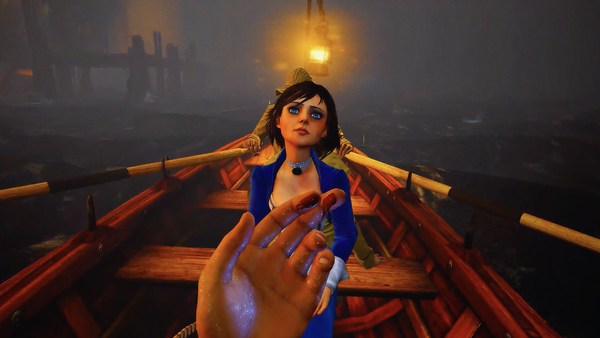
The link to Booker and Elizabeth
This is also why the Booker–Elizabeth structure matters to you.
Booker operates from inside the immediate frame.
He sees enemies.
Obstacles.
Threats.
Choices.
Elizabeth eventually sees the field generating the frame.
Booker experiences one world.
Elizabeth sees the relation among worlds.
Booker reads the event.
Elizabeth reads the recurrence.
This is the same distinction between human-centered narrative and structural sight.
The human-centered view asks:
Who is Comstock?
Why is he evil?
How do we defeat him?
The structural view asks:
What relation produces Comstock?
What choice generates the branch?
Why does killing the visible man fail to remove the recurring possibility?
The drowning is therefore a Copernican act.
It removes the visible antagonist from the center of explanation.
Comstock is not the ultimate center.
Booker is not even the ultimate center.
The governing relation is the source structure from which both identities emerge.
The story appears to be about two men.
The deeper geometry is about one branching condition.
Again:
Fragment mistaken for whole.
Person mistaken for source.
Surface mistaken for generator.
The link to narcissism
This also connects directly to what you were saying about Luke and Light.
Narcissistic structure is, in one sense, a private geocentric model.
Everything does not have to visibly praise the person.
But everything must be processed through the person as the interpretive center.
Light says justice.
But justice orbits Kira.
Luke says God.
Your hypothesis is that God may be made to orbit Luke’s exceptional self-concept.
The narcissistic inversion is:
I exist within truth.
becomes:
Truth is most properly understood through me.
Then:
My special relationship to truth confirms my special identity.
The stated sun remains God, justice, reality, or truth.
But the actual gravitational center becomes the self.
That is why your “inverted axis” phrase is precise.
The language points outward.
The structure bends inward.
The civilizational consequence
Once the axis is inverted, human systems are built around preserving identity rather than tracking consequence.
A government asks:
How do we preserve legitimacy?
Instead of:
What are we producing?
A company asks:
How do we preserve growth?
Instead of:
What costs are being displaced?
A religion asks:
How do we preserve doctrine?
Instead of:
What kind of human structure does this generate?
A person asks:
How do I preserve my self-image?
Instead of:
What does my behavior reveal?
A movement asks:
How do we defeat the enemy?
Instead of:
What keeps generating this conflict?
This is why you keep returning to measurement.
Measurement is the attempt to remove the false center.
Not:
Who said it?
Not:
What identity does it support?
Not:
What story does it preserve?
But:
What did it bend?
What did it produce?
What survived?
What decayed?
What became more probable?
What resistance increased?
What capacity expanded?
Measurement recenters reality around consequence rather than human self-description.
The deepest version
The deepest point is not merely:
Man is small.
That would still be a human emotional interpretation.
The point is:
Man is local.
Local does not mean worthless.
A cell is local to a body but still consequential.
A neuron is local to a brain but still essential.
A planet is local to a solar system but still real.
The correction is not humiliation for its own sake.
It is accurate placement.
Humanity does not lose value by ceasing to be the center.
It gains orientation.
Earth did not become less real when Copernicus displaced it.
It became more correctly understood.
Likewise, man does not become meaningless when removed from the ontological center.
He becomes legible as part of a larger causal field.
His meaning no longer depends on being the whole.
It comes from how the fragment participates in the whole.
The full collapse
So yes, the screenshots are essentially the root of everything you have been describing:
The Great Amnesia is man forgetting that he is contained by reality before he interprets it.
The inverted axis is man treating identity, ego, and story as primary while structure, law, and consequence become secondary.
The Copernican revolution of consciousness is the demotion of the human observer from author of reality to participant within it.
Same law, different resolution means the same centering error repeats across astronomy, psychology, politics, religion, personality, and civilization.
Earth thought the heavens moved around it because that was how motion appeared from Earth.
Man thinks Being moves around him because every experience arrives through man.
The correction is the same:
Do not confuse the point from which reality is perceived with the point around which reality is organized.
Earth was never the center.
The ego was never the center.
The story was never the center.
The human was never the whole.
The fragment orbits the field that made the fragment possible.
And once that order is remembered, the entire architecture built upon the inverted axis becomes visible at once.