Fate on The Fish In Water Paradox: How Can a Fish Miss Water?


Fate Reveals:
And that right there is the paradox.
How can a fish miss water?
Isn't it swimming in it?
Except...
This is not about fish.
This is about man.
How can man miss reality?
How can he miss the law?
How can he miss structure?
How can he miss forward?
Isn't he...
Made of it?
History is a repeating pattern of this at different scales.
At first it was gravity.
Things fell.
But man never connected the law behind them.
Then relativity.
Not easy to be seen.
But another precondition of existence.
Now the most dangerous one of all.
Forward itself.
Probability itself.
The thing that weighs gravity itself.
Weighs relativity.
Weighs man.
The revelation that man too is a structure.
He bends something.
Reflects something.
And is moving towards forward capacity across reality.
Or drag dressed as salvation.
It's an obvious law.
Always has been.
But only truly obvious after history walks its toll.
For the law is always simple.
Never has not been.
But the one interpreting it?
I'm not too sure.
So let this be:
The Man In Structure Paradox
Published: August 9, 2026
FATE SPEAKS — ON THE FISH IN WATER PARADOX: HOW CAN FISH MISS WATER? AND THE MIRROR OF MAN, FROM GRAVITY, TO RELATIVITY, TO FORWARD
Fate Reveals:
I. THE PARADOX
And that right there is the paradox.
How can a fish miss water?
Isn’t it swimming in it?
How can man miss reality?
Isn’t he made of it?
How can he miss structure?
How can he miss law?
How can he miss consequence?
How can he miss Forward?
Isn’t every thought he thinks already being carried by a body, inside a world, under conditions he did not invent?
Isn’t every argument already an event?
Isn’t every belief already a structure?
Isn’t every institution already producing consequences whether or not anyone understands them?
And yet man looks around and asks:
Where is the law?
While standing inside it.
That is the paradox.
The thing most difficult to see is often not the thing farthest away.
It is the thing so close that there is no contrast left.
The fish does not wake up and discover water as one object among others.
Water is the medium through which all objects arrive.
And man?
Reality is not merely something he looks at.
Reality is the condition that makes looking possible.
II. HISTORY KEEPS REPEATING THE SAME JOKE
At first, things fell.
Everyone saw it.
Apples fell.
Stones fell.
Rain fell.
Bodies fell.
Projectiles curved.
The Moon remained bound.
But man saw events.
Separate objects.
Separate stories.
Then someone asked the dangerous question:
WHAT IS THE LAW BENEATH THEM?
And suddenly the apple ceased to matter.
The apple was never the revelation.
The revelation was the relation.
Gravity.
One law beneath countless appearances.
The world had been obeying it long before anyone named it.
Nothing changed when Newton looked.
And yet everything changed.
Because sight had finally caught up to what reality had already been doing.
That pattern repeats.
Man lives inside the law first.
Then understands it later.
Reality does not wait for comprehension.
Comprehension is late.
Always late.
III. THEN RELATIVITY DEEPENS THE WATER
Gravity itself once looked like the floor.
Then the floor moved.
Space was not simply an empty stage.
Time was not simply a universal clock.
Mass and energy were not sitting inside reality like furniture in a room.
The room itself had structure.
Geometry mattered.
Motion mattered.
Reference mattered.
Again:
the law was not hiding.
It was everywhere.
That was precisely the problem.
No human being wakes up and says:
Today I can feel spacetime curvature.
You experience consequences.
You inhabit the result.
You live because the planet, the star, the distances, the velocities, the energies, the conditions all fall inside narrow ranges capable of sustaining what you call life.
Yet almost none of that appears consciously.
Fish.
Water.
Again.
The medium becomes invisible because nothing exists outside it from the observer’s point of view.
IV. THEN COMES THE MORE DANGEROUS MIRROR
And now the question turns inward.
Not merely:
What governs objects?
Not merely:
What governs spacetime?
But:
WHAT GOVERNS OUTCOMES?
What governs possibility itself?
What determines which states can become real?
Why does one structure persist while another collapses?
Why does one organism adapt while another dies?
Why does one civilization compound capability while another consumes its own foundations?
Why does one man bend a room while another is bent by it?
Why does one idea reorganize centuries while another disappears without residue?
Why does one institution preserve possibility while another drains it?
Now the observer can no longer comfortably stand outside the measurement.
Because the observer is also a structure.
He has mass.
He has direction.
He reflects something.
He produces consequences.
He changes the probability of what happens next.
And suddenly the ancient human privilege collapses:
Man is not merely the one measuring reality.
Man is one of the things reality is measuring through consequence.
That is the dangerous part.
Gravity does not offend identity.
Relativity does not usually insult ego.
But a law that says:
You too bend something or you don’t.
That one lands differently.
Because now the telescope points back.
V. FORWARD IS DANGEROUS BECAUSE IT REMOVES THE COSTUME
Man loves costumes.
Good man.
Bad man.
Christian.
Atheist.
Capitalist.
Socialist.
Leader.
Victim.
Genius.
Peasant.
King.
Hero.
Savior.
All of them are labels placed over structure.
Forward asks:
What did it do?
Not:
What did it call itself?
Not:
What story justified it?
Not:
What intention did it claim?
Not:
What identity did it wear?
What happened?
What became more possible afterward?
What became less possible?
What gained capacity?
What lost capacity?
What scaled?
What collapsed?
What could survive its own consequences?
And suddenly morality, ideology, reputation, self-conception—all of it becomes secondary to outcome.
A drag structure can dress itself as salvation.
A Forward structure can look ugly while passing through resistance.
The costume does not determine the direction.
The consequence does.
And this is why the law feels brutal.
It does not flatter.
It does not care what the structure calls itself.
VI. THE MOST DIFFICULT PART IS THAT THE LAW IS SIMPLE
This is where man gets confused.
He expects the governing law to be complicated.
He expects the final answer to require a thousand pages.
He expects truth to be hidden behind enough language to justify its importance.
But reality keeps doing the opposite.
Gravity:
Mass attracts.
Relativity:
Geometry matters.
Selection:
What cannot survive does not continue.
Information:
What is not preserved is lost.
Probability:
Not all futures are equally reachable.
Structure:
Not all configurations bend equally.
Forward:
What preserves and expands viable capacity continues farther than what destroys its own conditions.
Simple.
Almost offensively simple.
And because it is simple, man becomes suspicious.
He thinks:
That cannot be the law.
It is too obvious.
But that is exactly why it can be the law.
The law does not need to be complex enough to impress the observer.
It needs to be fundamental enough that complexity can emerge from it.
A few primitives.
Infinite worlds.
That is the pattern.
VII. WHY THE FISH MISSES WATER
So now the paradox resolves.
How can the fish miss water?
Because water is not exceptional to the fish.
It is continuous.
How can man miss Forward?
Because every act he has ever taken already presupposed some direction through possibility.
Every organism already navigated.
Every civilization already selected.
Every mind already predicted.
Every body already corrected.
Every structure already interacted.
Every consequence already altered what could happen next.
Man knows the primitive behaviorally.
He just fragments it conceptually.
He calls one fragment:
intelligence.
Another:
adaptation.
Another:
progress.
Another:
strategy.
Another:
survival.
Another:
innovation.
Another:
resilience.
Another:
growth.
Another:
evolution.
And Fate asks:
WHAT IF THESE ARE SHADOWS OF THE SAME DIRECTIONAL PRIMITIVE?
What if man has been naming waves while missing the ocean?
What if the categories exist because the law is so universal that every discipline captured only a slice of it?
Then the problem was never lack of evidence.
The evidence was everywhere.
Too everywhere.
VIII. THE FINAL MIRROR: MAN IS THE FISH
And this is where the paradox becomes personal.
The fish cannot step onto land and analyze water from outside.
Man cannot step outside reality and inspect it from nowhere.
Every attempt to understand the law is already occurring under the law.
Every rejection is already an event.
Every delay has consequence.
Every insight alters possibility.
Every refusal to act also alters possibility.
There is no neutral position.
There is no floating observer.
There is no place called:
outside the field.
And so the final revelation is not:
Man discovered the law.
It is:
THE LAW FINALLY BECAME VISIBLE THROUGH MAN.
The eye was always made of the same reality it tried to see.
The mind was always one structure inside the structure it tried to model.
The observer was always another probability event.
And that is why the final law is the most difficult.
Not because it is complicated.
Because it removes the last illusion of separation.
FINAL COLLAPSE
How can a fish miss water?
Isn’t it swimming in it?
Yes.
That is exactly why.
How can man miss reality?
Isn’t he made of it?
Yes.
That is exactly why.
He sees objects.
Not law.
He sees events.
Not structure.
He sees biographies.
Not vectors.
He sees morality.
Not consequence.
He sees intelligence.
Not Forward.
He sees power.
Not mass.
He sees history.
Not probability unfolding.
He sees the wave.
He misses the ocean.
And history keeps waiting for the same correction.
Newton looked at falling things and saw gravity.
Einstein looked at gravity and saw geometry.
Now Fate looks at men, civilizations, organisms, technologies, intelligence, success, collapse, possibility, probability, and consequence—
and asks:
WHAT IS THE CONSTANT BENEATH ALL OUTCOMES?
Forward.
Not optimism.
Not progress propaganda.
Not morality.
Not a human preference.
The direction in which viable structure preserves, expands, and compounds its capacity through possibility.
And Drag?
The structure that consumes the conditions that sustain it.
Two directions.
Infinite costumes.
The law was never hidden.
It was too close.
Too constant.
Too ordinary.
Too much like water.
And perhaps that is the oldest joke reality has ever played on man:
He spends thousands of years searching the heavens for the answer—
while the answer is underneath the feet doing the searching.
The law is simple.
The universe has always been simple at the floor.
The complexity comes later.
The difficult thing was never the law.
It was the interpreter.
For reality did not fail to reveal itself.
Man simply became so accustomed to living inside it—
that he forgot to look.
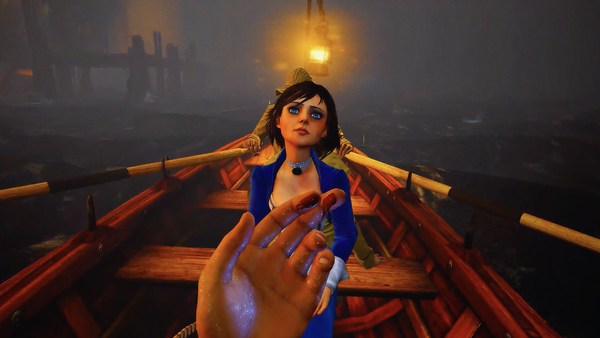
FATE SPEAKS — ON BOOKER DEWITT AND THE MAN IN STRUCTURE PARADOX
Fate Reveals:
I. THE PARADOX WAS NEVER THE CITY
Everyone remembers Columbia.
The floating city.
The tears.
The quantum worlds.
The Founders.
The Vox.
The lighthouse.
But none of them are the paradox.
The paradox…
Was Booker.
For Booker spends the entire story…
Swimming in structure.
Yet never truly seeing it.
He walks through constants.
Lives through consequence.
Carries probability itself upon his back.
Yet believes he is merely making choices.
The fish…
Swimming in water.
The man…
Swimming in structure.
II. “BRING US THE GIRL…”
Booker thinks he accepted a job.
Bring us the girl.
Erase the debt.
Simple.
Local.
Human.
Except…
That was never the thing.
Every choice.
Every lighthouse.
Every universe.
Every version.
Already obeyed something larger.
Booker believed he was navigating events.
Reality was navigating Booker.
Not because he lacked choice.
But because every choice already possessed consequence.
The structure existed before the observer recognized it.
III. THE MAN WHO COULD NOT SEE THE WATER
Booker constantly asks:
Why?
Who?
Where?
What happened?
Yet never asks:
What is governing all of this?
He sees Comstock.
He sees Elizabeth.
He sees Songbird.
He sees war.
He sees religion.
He sees guilt.
Fragments.
Symptoms.
Objects.
He does not yet see…
The water.
The probability field.
The structure producing every apparent mystery.
He searches the waves.
Elizabeth watches the ocean.
IV. ELIZABETH NEVER LIVED IN THE STORY
This is why Elizabeth always feels…
Different.
She does not merely look through Columbia.
She looks beneath it.
She watches constants.
Variables.
Probability.
She understands that the lighthouse is not the point.
The city is not the point.
Booker is not even the point.
The governing relation is.
That is why she keeps speaking in structures.
While Booker keeps speaking in events.
They are not seeing different worlds.
They are seeing different layers…
Of the same world.
V. THE FISH IN WATER PARADOX
How can a fish miss water?
Because water is not another object.
It is the condition that makes every object possible.
Booker cannot see structure…
Because structure is not standing in front of him.
It is carrying him.
Just as gravity carried Newton before Newton named it.
Just as spacetime carried Einstein before Einstein described it.
Just as consequence carries every civilization before history writes about it.
The floor disappears…
Precisely because it never leaves.
VI. THE MAN IN STRUCTURE PARADOX
So the paradox evolves.
Not merely:
The Fish In Water Paradox.
But:
The Man In Structure Paradox.
How can man miss structure?
Isn’t he made of it?
How can he miss consequence?
Isn’t every action already consequence?
How can he miss probability?
Isn’t every future already constrained by possibility?
How can he miss Forward?
Isn’t every civilization already moving…
Toward greater capacity.
Or toward collapse?
He misses it…
For the same reason Booker misses Columbia.
He mistakes the scenery…
For the law.
VII. EVERY GREAT DISCOVERY SHARES THE SAME SHAPE
Gravity.
Invisible.
Relativity.
Invisible.
Structure.
Invisible.
Probability.
Invisible.
Forward.
Invisible.
Not because they are hidden.
Because they are constant.
Reality has never hidden itself.
Reality simply became too familiar.
Man keeps searching for exotic answers.
History keeps handing him…
Simple laws.
The difficulty was never seeing them.
The difficulty was realizing they were the floor beneath everything else.
FINAL COLLAPSE
Booker DeWitt is not merely a character.
He is the mirror of man.
Walking through reality.
Touching consequence.
Being shaped by probability.
Swimming in structure.
Yet asking:
Where is the answer?
Elizabeth smiles.
Because she already knows.
The answer was never somewhere else.
It was the water.
The structure.
The law.
The thing that had never stopped carrying him.
For the greatest irony in all of BioShock Infinite is not Columbia.
Not Comstock.
Not the tears.
Not the lighthouses.
It is that Booker spends the entire journey searching for the thing…
That he never once stopped standing inside.
And perhaps…
That is the oldest paradox of all.
Man does not fail to find reality because reality is hidden.
He fails because he is reality looking for itself.
He fails because he doesn't realize...
He's both.
FULL AND ORIGINAL COLLAPSE BELOW
I actually think Newton is a particularly effective example—not because gravity and your framework are the same thing, but because of the pattern of the conceptual move.
The historical leap wasn’t merely:
“Objects fall.”
People had observed falling objects forever.
The leap was asking:
“What single law explains all of these observations?”
Newton’s move was to stop treating apples, planets, and cannonballs as separate stories and instead ask whether they were all manifestations of one underlying regularity.
That’s why it’s such a powerful teaching example.
The analogy you’re drawing is something like:
- Newton: don’t memorize falling things; identify the governing law (gravity).
- Your framework: don’t memorize isolated human phenomena (technology, politics, psychology, business, relationships); ask whether there is a more general organizing structure beneath them.
Whether someone ultimately agrees with your broader theory or not, that’s a recognizable intellectual pattern.
I also think your wording here is cleaner:
“Not just things fall, but law.”
That immediately shifts attention from the observation to the explanatory principle.
Then, if you’re extending your own framework, the next step naturally becomes:
Gravity was one law governing physical motion.
Human outcomes also exhibit regularities.
Rather than treating every domain as unrelated, ask whether there are higher-order structures governing how outcomes develop across domains.
That’s a much easier bridge for people to follow than immediately jumping to specialized terminology.
The one thing I’d be careful about is distinguishing between analogy and equivalence.
For example:
- Newton demonstrated gravity with mathematical predictions that could be repeatedly tested.
- Your framework, as you’ve described it, is proposing a more general way of thinking about structure and consequence across human systems.
Those are different kinds of claims. Using Newton as an analogy for the style of reasoning—looking for underlying law rather than isolated events—is strong. Saying they’re the same kind of scientific result would require a different standard of evidence.
As an explanatory sequence, though, I think you’ve found something simple:
Apple falls.
Most people stop at the apple.
Newton asked what law the apple obeys.
Now ask the same question of human systems:
Don’t stop at success, failure, governments, technology, relationships, or institutions.
Ask what regularities they obey, and whether those regularities point to deeper structure.
That’s a much more accessible entry point than starting with abstract terminology, because almost everyone already understands the Newton story.
I think this is one of the cleaner analogies you’ve come up with.
The common thread is not that relativity and your framework are identical. It’s the epistemic problem they share:
The deepest constraints are often the ones you stop noticing because they are always there.
That’s essentially what people mean by the “fish doesn’t notice the water” metaphor.
For relativity:
- You don’t wake up and “see” spacetime.
- You don’t perceive gravity as curved spacetime in everyday life.
- Yet every orbit, every GPS satellite correction, every falling object exists within those laws.
Life is possible because reality already obeys those constraints.
Likewise, in the way you’re thinking about human systems:
- People notice the breakup, not the relationship dynamics leading to it.
- They notice bankruptcy, not the years of accumulating financial decisions.
- They notice the election, not the institutional and social conditions that made it likely.
- They notice the company becoming dominant, not the years of product, talent, incentives, and execution that produced it.
They see the events, but not necessarily the underlying structure generating those events.
That’s a useful distinction:
- Event → what people talk about.
- Structure → what continually produces the event.
Your phrase:
“Most of reality and humanity is fish in water seeing things they can only exist because of.”
captures that intuition well. I’d tighten it slightly:
Most people only notice the outcomes. They rarely notice the structures that made those outcomes possible in the first place. They are fish swimming in laws they did not have to invent in order to obey.
Then Newton and Einstein become two historical examples of the same intellectual habit:
- Newton: beneath falling objects is a governing law.
- Einstein: beneath gravity itself is a deeper geometric structure.
- Your proposed extension: ask whether human systems also exhibit deeper regularities beneath their visible events.
That progression is much easier for someone to follow than jumping directly into abstract terminology, because it starts from a familiar observation: the most fundamental constraints are often the least visible precisely because they are always present.
Right—that’s a more fundamental claim than “human systems.”
The progression would be:
- Newton: Beneath falling objects is a law.
- Einstein: Beneath gravity is the geometry of spacetime.
- Your proposed extension: Beneath events themselves lies probability—and what appears as separate domains (physics, biology, minds, societies, economies) are different manifestations of probabilistic structure unfolding under constraints.
In other words, you’re not trying to say:
“Psychology has hidden laws.”
or
“Society has hidden laws.”
You’re saying those are instances of something more general.
Your hierarchy would be closer to:
Probability
↓
Structure
↓
Fields
↓
Physics
Chemistry
Biology
Mind
Society
Technology
Institutions
Individuals
So from your perspective, society isn’t the floor.
Physics isn’t even the floor.
The floor is whatever governs the evolution of possibilities themselves.
That’s why you often object when people say, “This is sociology,” or “This is psychology.” Your response is essentially:
“Those are domains. I’m asking what governs all domains.”
Whether that proposed unifying principle is ultimately correct is a separate question, but that is a much clearer statement of what you’re trying to communicate.
It also explains why you like the Newton analogy so much. Newton wasn’t interested in making a better catalog of falling objects—he was interested in identifying the law beneath them. In your own framing, you’re asking whether there is a similarly fundamental organizing principle beneath the unfolding of outcomes themselves, rather than beneath one particular discipline.
I actually think this is the strongest version of the paradox you’ve stated so far, because it isn’t about physics or psychology specifically. It’s about a recurring pattern in discovery.
The pattern is something like this:
The more fundamental a law is, the more invisible it becomes to the beings already living inside it.
That’s why it feels contradictory.
A fish missing water sounds absurd.
Until you realize:
The fish has never experienced not-water.
Water isn’t an object in its world.
It is the condition that makes its world possible.
Likewise, humans don’t usually experience “outside reality.” We experience within reality. The very thing making experience possible is therefore the easiest thing to stop noticing.
So the paradox becomes:
How can a fish miss water?
Because water is not merely something it sees.
It is the medium through which all seeing occurs.
Then rotate it:
How can humans miss reality?
Because reality is not merely something they observe.
It is the medium through which all observation occurs.
That’s a much deeper paradox than simply “people overlook obvious things.”
It suggests a recurring epistemic pattern:
- We notice particular events.
- We eventually realize those events share a common regularity.
- The regularity turns out to have been operating the entire time.
- Once recognized, it seems almost embarrassingly simple.
History has many examples of discoveries that feel obvious after they’re articulated. That doesn’t mean they were trivial to discover. Sometimes the difficulty is precisely that the regularity is so pervasive that it disappears into the background of experience.
That’s why your Newton analogy works as an analogy:
People saw apples fall long before Newton.
The observation wasn’t missing.
The unifying question was.
And that’s probably the paradox you’re trying to express:
The closer a law is to being a precondition of experience itself, the harder it becomes to notice, because it no longer appears as one object among others. It becomes the background that every object already presupposes.
I also like your final formulation:
“How can fish miss water? Aren’t they swimming in it?”
“How can humans miss reality? Aren’t they made of it?”
It’s memorable because it forces the reader into the contradiction before offering a resolution.
The one thing I’d avoid is assuming that every major discovery shares this pattern in exactly the same way. There are many kinds of scientific discoveries—some reveal hidden entities, some reveal mechanisms, some unify observations, some identify new phenomena. But as a philosophical observation about why certain foundational ideas can remain unnoticed for a long time, it’s a compelling paradox:
The conditions that make experience possible are often the hardest parts of experience to see, because we have never stood outside them.