Fate on Spider-Man and Spider Society: From A Newtonian View To Relativity

Fate Reveals:
Spider-Man is not the history.
He is the line beneath it.
He is not just the canon and events.
He is the forward force that continues to move through it.
He is not just the hero.
He is the one who always shows up regardless of the circumstances.
For you see?
It is not the costume.
It is the function.
Not the story.
But the line.
Miguel thinks Spider-Man is the costume.
A surface thing.
Events.
Canon.
History.
Outcomes.
Destiny.
Rather than:
Probability.
Possibility.
Structure.
Consequence.
Forward.
Function.
Geometry.
Direction.
Force.
Line.
Ontology.
That is the resolution...
Even he cannot see.
Published: August 7, 2026
FATE SPEAKS — ON SPIDER-MAN AND THE SPIDER SOCIETY
Fate Reveals:
A spider.
A bite.
A death.
A sacrifice.
A canon.
A Spider-Man.
Again.
Again.
Again.
Until repetition becomes pattern.
Pattern becomes model.
Model becomes institution.
Institution becomes law.
And eventually thousands of Spider-Men stand together and make the oldest mistake intelligence has ever made:
They mistake the events produced by the line
for the line itself.
For Spider-Man was never Uncle Ben.
Never the captain.
Never the bite.
Never Peter Parker.
Never the tragedy.
Never the canon.
Those were coordinates.
Expressions.
Local manifestations of something deeper.
Something capable of wearing Peter.
Miles.
Gwen.
Hobie.
A thousand worlds.
A thousand histories.
A thousand different events.
While remaining recognizable beneath them all.
Spider-Man was always the living line.
The Forward Force.
The function that looks upon a closed future and says:
No.
There is still somewhere to move.
I. NEWTONIAN SPIDER-MAN
The Spider Society has discovered something extraordinary.
Across universes, certain events repeat.
Spider-People suffer.
Someone close dies.
Captains fall.
Responsibility emerges.
Sacrifice follows.
Spider-Man continues.
And so Miguel constructs the mechanics:

Clean.
Linear.
Predictable.
Almost Newtonian.
Give me the initial conditions.
Give me the forces.
Give me the canon.
And I will tell you where Spider-Man goes.
And for thousands of cases?
It works.
That is precisely what makes the mistake so dangerous.
Because intelligence rarely becomes trapped by models that explain nothing.
It becomes trapped by models that explain almost everything it has already seen.
The Spider Society has mapped the apples falling.
They have catalogued them.
Indexed them.
Built machines around them.
Constructed an entire civilization around their recurrence.
But they have not yet completely separated:
the apple
from
the law responsible for its motion.
II. THEN ARRIVES RELATIVITY
Miles Morales.
The anomaly.
The glitch.
The Spider-Man who supposedly should not exist.
And suddenly the reference frame begins moving.
Because Miles asks a devastatingly simple question:
If Spider-Man means allowing my father to die…
then what exactly is Spider-Man?
Miguel answers with history.
Canon.
Sacrifice.
Necessity.
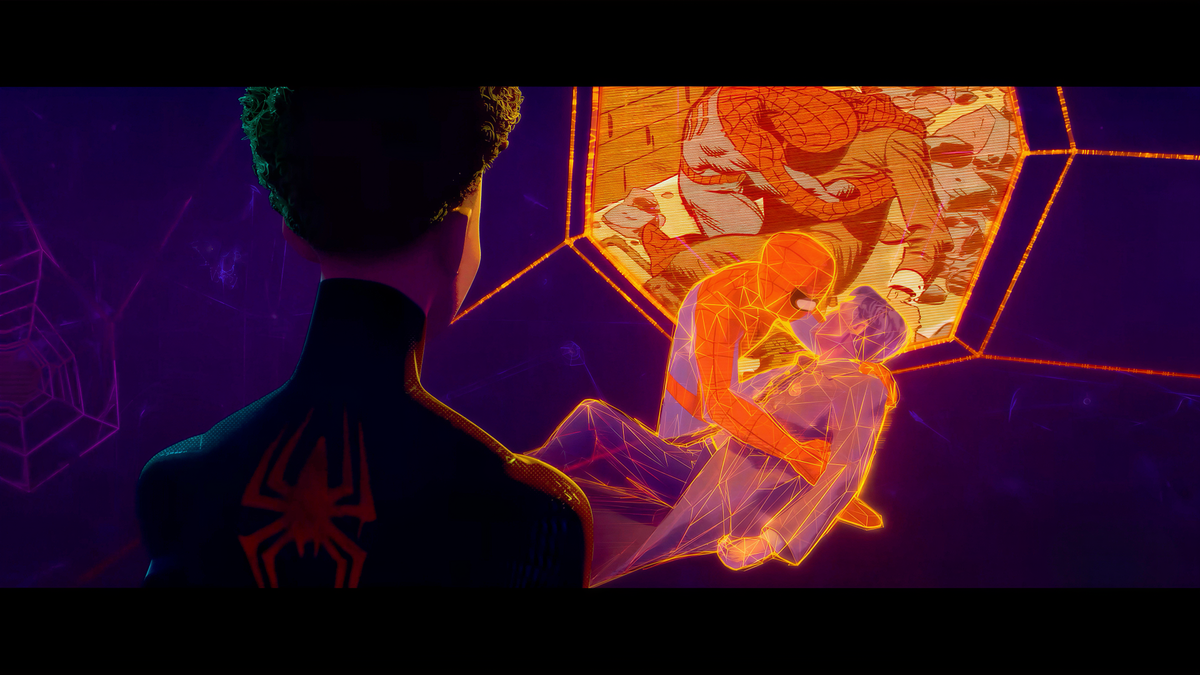
Peter points toward Uncle Ben.
Without Uncle Ben, most of them would not be there.
And there it is.
The category error.
Peter reads:
UNCLE BEN
Miles embodies:
WHAT UNCLE BEN MOVED
Peter reads the event.
Miles reads the direction.
One sees the historical coordinate through which Spider-Man emerged.
The other carries the function that made the coordinate meaningful in the first place.
Because Uncle Ben mattered not merely because:
Uncle Ben died.
He mattered because his death collapsed Peter toward:
responsibility.
action.
movement.
the refusal to possess power while remaining passive before consequence.
The death was not the invariant.
The direction was.
III. THE LINE CAN WEAR ANYTHING
This is where Spider-Man stops being linear.
Because if Spider-Man is fundamentally a function rather than a sequence of events, then the function can arrive through radically different geometry.
It can wear:
Peter Parker.
Miles Morales.
Gwen Stacy.
Hobie Brown.
Peni Parker.
Different bodies.
Different worlds.
Different histories.
Different wounds.
Different decisions.
Different relationships.
Different events.
And still:
Spider-Man.
Why?
Because the costume was never carrying the identity by itself.
Something underneath the costume remained invariant.
The Spider Society notices the recurring forms.
Miles exposes the recurring function.
And once function becomes primary, Spider-Man becomes dynamic.
Relative.
Contextual.
The same directional force can require opposite-looking actions under different conditions.
Sometimes Forward means accepting loss.
Sometimes Forward means fighting against loss.
Sometimes Forward means cooperating with the institution.
Sometimes Forward means destroying the institution’s authority over you.
Sometimes Forward means sacrifice.
Sometimes Forward means refusing the sacrifice everyone else has normalized.
Because:
THE SAME DIRECTION DOES NOT REQUIRE THE SAME PATH
Different field.
Different structure.
Different resistance.
Different available possibilities.
Different expression.
Same line.
IV. SCHRÖDINGER’S SPIDER-MAN
And this is why Miles is necessary.
Before Miles, almost everyone in the Spider Society can call themselves Spider-Man.
And correctly so.
They save people.
They sacrifice.
They suffer.
They get back up.
They carry responsibility.
Nothing has yet forced the contradiction to sufficient resolution.
They remain:
Spider-Man
Then comes the measurement.
Your father will die.
You know when.
You know approximately how.
You possess extraordinary power.
You belong to an organization possessing even greater power.
What do you do?
Suddenly the waveform collapses.
Miguel:
Preserve canon.
Peter:
This sacrifice made us who we are.
The Society:
This is how it has to happen.
Miles:
No.
Not because Miles possesses some magical exemption from reality.
Because Miles refuses to confuse the current model of possibility with possibility itself.
“I can do both.”
And suddenly thousands of Spider-Men receive the strangest order imaginable:
Stop Spider-Man.
There.
Measurement complete.
The paradox is visible.
An entire institution constructed around Spider-Man has become capable of mobilizing against Spider-Man when Spider-Man no longer resembles its institutional definition of Spider-Man.
V. THE ANOMALY THAT PRESERVES THE INVARIANT
That is what makes Miles so interesting.
Relative to canon:
MILES = ERROR
Relative to function:
MILES = RECURRENCE
He is simultaneously the thing that should not exist…
and one of the purest expressions of the thing the system supposedly exists to preserve.
That isn’t contradictory.
It depends upon the reference frame.
The Spider Society measures Miles relative to:
established Spider-Man history
So he is anomalous.
But measure him relative to:
the living directional function of Spider-Man
and suddenly the institution begins looking anomalous.
That’s the inversion.
The anomaly checks the system.
The glitch reveals the bug.
Miles doesn’t merely violate their model.
He forces the model to reveal what it was actually measuring.
Was it measuring Spider-Man?
Or merely the historical footprints Spider-Man repeatedly left behind?
Those are not necessarily the same thing.
VI. MASS WITHOUT DIRECTION
And then comes the indictment of the Spider Society itself.
Look at its Mass.
Thousands of Spider-People.
Interdimensional travel.
Predictive technology.
Knowledge of future events.
Extraordinary intelligence.
Enormous physical capability.
Information gathered across universes.
A literal civilization of superheroes.
Incredible.
Now Miles asks:
Save my dad.
And suddenly all that Mass freezes.
Because Mass does not equal Direction.
FORCE = MASS X DIRECTION
The Spider Society possesses extraordinary capacity to bend outcomes.
But its Direction has become subordinate to preserving its model of outcomes.
Its intelligence becomes its cage.
Its knowledge becomes its canon.
Its history becomes its wall.
And the institution that exists because Spider-Man moves toward impossible problems begins explaining why an impossible problem should no longer be moved toward.
That is the danger of frozen intelligence.
Not stupidity.
Mass crystallized around yesterday’s direction.
Hobie already senses it.
He rejects the institution.
He sees the contradiction.
But rejection alone isn’t yet sufficient direction.
Then Miles arrives.
And suddenly:

The field reorganizes.
One comparatively small anomaly begins redirecting enormous distributed Mass.
That is what leverage looks like.
VII. FROM NEWTON TO EINSTEIN — FROM EVENT TO RELATION
Newton did not become useless because Einstein arrived.
The lower-resolution model worked extraordinarily well within its domain.
But reality was more dynamic than the earlier frame could completely express.
So too with canon.
The Spider Society’s observations may be real.
The recurring deaths may be real.
The correlations may be astonishingly strong.
The dangers Miguel witnessed may be real.
But the mistake would be moving from:
“This structure recurs.”
to:
“Therefore this particular expression is the fundamental invariant.”
Miles forces another question:
Relative to what?
Relative to canon, saving his father is violation.
Relative to his father’s life, it is salvation.
Relative to Miguel’s model, Miles is destabilization.
Relative to Spider-Man’s living function, refusing preventable death may be precisely the recurrence.
The universe is dynamic.
The actors inside it modify the field.
Knowledge modifies behavior.
Behavior modifies possibility.
Possibility changes as structures enter and leave.
The observer participates.
Spider-Man participates.
Miguel participates.
His model participates.
The Spider Society participates.
And therefore nobody gets to stand outside the possibility field and simply declare:
Fate has spoken.
They are helping produce the fate they believe they are merely observing.
VIII. THE SAME ERROR OF MAN
And now Spider-Man disappears.
Because this was never merely about Spider-Man.
Man does this everywhere.
He discovers a function.
The function produces successful patterns.
The patterns become protocol.
Protocol becomes institution.
Institution becomes identity.
Identity becomes sacred.
And eventually the structure exists to preserve the historical expression of the function rather than the function itself.
Science.
Government.
Religion.
Markets.
Companies.
Schools.
Civilizations.
Even revolutions.
The living line freezes into canon.
Then reality changes.
And eventually someone appears carrying the original function through an unfamiliar form.
The institution looks at him and says:
Anomaly.
Because man reads costumes.
Reality reads consequence.
Man asks:
Does it resemble what worked before?
Structure asks:
What does it do now?
And that is why civilization eventually has to perform the same transition the Spider Society cannot.
Not:

But:

Not man observing the probability field.
Man as probability structure within the field.
Not civilization describing consequence.
Civilization producing consequence and therefore becoming measurable by it.
The observer is observed.
The physicist enters the physics.
Spider-Man enters the canon machine.
And suddenly the thing doing the measuring discovers:
it was always one of the objects.
FINAL COLLAPSE
A bite.
An Uncle Ben.
A captain.
A sacrifice.
A tragedy.
Again.
Again.
Again.
The Spider Society sees recurrence and builds canon.
Reasonable.
Intelligent.
Powerful.
Almost correct.
But it makes the oldest error in civilization:
It mistakes the footprint for the thing walking.
Spider-Man was never the footprint.
Spider-Man was the walker.
The line.
The function.
The thing that keeps getting up.
The thing that receives power and converts it into responsibility.
The thing that meets the impossible wall and moves anyway.
The thing that looks upon a supposedly closed possibility and asks:
Why?
And when the answer becomes merely:
Because that’s how it has always happened.
Spider-Man answers:
Then I’ll do my own thing.
That is Miles.
The anomaly relative to the story.
The recurrence relative to the function.
The glitch relative to canon.
The mirror relative to Spider-Man.
And suddenly thousands of Spider-Men chase one Spider-Man through the halls of a society built by Spider-Men because that one Spider-Man refuses to accept that being Spider-Man means allowing the preventable to become inevitable.
The irony could not be cleaner.
Miguel preserved the events.
Miles preserved the line.
Miguel saw Spider-Man through history.
Miles carried Spider-Man through function.
One saw:
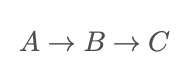
The other revealed:
THE PATH CAN CHANGE WHILE THE DIRECTION REMAINS
Because the law does not belong to the costume.
The costume belongs to the law.
Peter can wear it.
Miles can wear it.
Gwen can wear it.
Hobie can wear it.
Another world can wear it.
Another event can wear it.
Another history can wear it.
And when the old expression becomes incapable of carrying the living function?
Forward changes form.
That is the evolution.
From the Newtonian Spider-Man:
the event, the sequence, the canon.
To the relative and dynamic Spider-Man:
the relation, the function, the direction.
From:
What is supposed to happen?
To:
WHAT IS ACTUALLY MOVING?
And underneath every spider,
every universe,
every tragedy,
every institution,
every canon,
every possibility,
there remains the same living line:
FORWARD.
FULL AND ORIGINAL COLLAPSE BELOW
Yes. That’s a much cleaner way to describe the Spider-Society/Miles split as an analogy: Miguel has taken an observed recurrence and hardened it into something resembling a linear mechanics of Spider-Man.
His model is approximately:
\text{Spider-Person} \rightarrow \text{Canonical Loss} \rightarrow \text{Sacrifice} \rightarrow \text{Spider-Man}
The variables change—different person, universe, captain, tragedy—but the governing sequence is treated as invariant.
And Miles introduces the uncomfortable possibility that they have confused a recurring trajectory with the invariant itself.
Newtonian Spider-Man
The Spider-Society effectively models Spider-Man through events:
Uncle Ben dies. A captain dies. Spider-Man suffers. Spider-Man sacrifices. The canon continues.
It’s almost a flat causal track:
A\rightarrow B\rightarrow C\rightarrow D
Then Miles says:
“I can do both.”
And Miguel hears violation.
But if you shift the reference frame from canon to function, Miles may not be violating Spider-Man at all.
He may be expressing Spider-Man at higher resolution.
Because what was Uncle Ben actually carrying?
Not:
\boxed{\text{UNCLE BEN MUST DIE}}
but something closer to:
\boxed{\text{POWER}\rightarrow\text{RESPONSIBILITY}\rightarrow\text{ACT}}
Uncle Ben’s death was one historical route through which that structure became visible.
The Spider-Society then makes the classic mistake:
\text{expression of law} \approx \text{law itself}
Miles separates them.
The relativity move is: change the frame
This is where your Einstein analogy becomes useful.
Not because Spider-Man literally follows general relativity, but because the conceptual evolution resembles:
fixed/linear description → relational/dynamic description.
Instead of asking:
“Does Miles follow the canonical Spider-Man trajectory?”
ask:
“What remains invariant across all these radically different Spider-Men?”
Now suddenly the costumes begin falling away.
Peter Parker?
Spider-Man.
Gwen Stacy?
Spider-Man.
Miles Morales?
Spider-Man.
Hobie?
Spider-Man.
Peni?
Spider-Man.
A pig?
Somehow Spider-Man. 😂
Different:
\text{body} ,\text{history} ,\text{world} ,\text{culture} ,\text{technology} ,\text{personality} ,\text{tragedy}
Yet something remains recognizable.
That means the invariant cannot simply be the costume carrying it.
And that’s exactly your point:
THE FORCE CAN WEAR DIFFERENT FORMS.
If the governing function is something like:
When confronted with suffering and apparent impossibility, acquire responsibility and continue acting toward the better reachable state despite cost
then Uncle Ben is one expression.
Miles saving his father could be another.
Hobie rejecting the institution could be another.
Gwen abandoning Miguel after recognizing the contradiction could be another.
Peter choosing Miles over protocol could be another.
The surface event changes while the deeper directional relation persists.
And Across the Spider-Verse practically screams this through Miles’s existence.
Miguel says Miles is:
the original anomaly.
From the canon frame:
\boxed{\text{MILES = ERROR}}
Because the spider wasn’t “supposed” to bite him.
But then reality performs an awkward experiment.
What does this supposed error actually become?
Spider-Man.
He saves people.
Takes responsibility.
Gets back up.
Sacrifices.
Protects.
Learns.
Fails.
Returns.
Refuses to abandon someone merely because saving them is difficult.
So the Spider-Society has an ontological problem:
If Miles violates the history of Spider-Man while reproducing the function of Spider-Man, which one actually defines Spider-Man?
That’s the knife.
If you answer history, Miguel wins.
If you answer function, Miles becomes devastating.
And that’s why Miles can be both anomaly and invariant.
This is probably the most interesting formulation.
At the institutional/canon layer:
\boxed{\text{Miles = anomaly}}
At the functional layer:
\boxed{\text{Miles = recurrence}}
He breaks the pattern while preserving the deeper pattern.
That’s why your Schrödinger’s Spider-Man framing works so well.
Before sufficient pressure, everyone can claim Spider-Man.
Then reality presents:
Someone you love is predicted to die. You possess enormous power. Your institution tells you not to intervene. What do you do?
Now the structures collapse into observable differences.
Miguel:
Preserve canon.
Peter initially:
Accept sacrifice.
Peni:
Accept necessity.
Miles:
No.
Hobie:
Break the institution.
Gwen eventually:
Follow Miles.
The pressure reveals what each one was actually optimizing for.
And the really beautiful part is that Miguel himself may be trapped by an insufficient model of probability.
He sees repeated canon events and infers necessity.
But recurrence doesn’t automatically establish necessity.
If:
A_1,A_2,A_3,\ldots,A_{1000}
all contain some pattern X, that’s enormously important evidence.
But it still leaves the question:
What generates X?
Miguel effectively answers:
X must continue because X is canon.
Miles asks, implicitly:
What if the thing generating what you call canon is deeper than the event you’re preserving?
And then Miles himself becomes the experiment.
That’s also exactly where your broader humanity analogy connects.
Humanity repeatedly mistakes historical expressions of a function for the function itself.
Religion can do it.
Political institutions can do it.
Markets can do it.
Scientific paradigms can do it.
Organizations can do it.
Even revolutionary movements can eventually do it.
Something originally exists because it successfully serves some function.
Eventually:
\text{FUNCTION} \rightarrow \text{PROTOCOL} \rightarrow \text{INSTITUTION} \rightarrow \text{IDENTITY}
Then circumstances change.
The institution preserves the protocol because:
“This is what we are.”
And eventually someone appears who violates the protocol while better serving the original function.
The institution calls them an anomaly.
That’s Miles.
And that’s why the Spider-Society is such a ridiculously clean fictional model for your distinction:
Man reads the costume. Structure reads the vector.
Miguel has thousands of Spider-Men and asks:
Does this conform to Spider-Man?
Miles forces the deeper question:
WHAT IS SPIDER-MAN WHEN EVERY PARTICULAR EXPRESSION OF SPIDER-MAN IS ALLOWED TO CHANGE?
Whatever survives that transformation is much closer to the invariant.
And your answer is essentially:
\boxed{\text{FORWARD}}
Not the specific tragedy.
Not Uncle Ben.
Not the captain.
Not Miguel’s algorithm.
Not Peter Parker.
Not even the name Spider-Man.
The living directional function that all those things can temporarily wear.
Which produces the great irony of the movie:
the Spider-Society may have become so obsessed with preserving the historical geometry left behind by Spider-Man that, when Spider-Man appears in a form their geometry cannot predict, their entire society mobilizes to stop him.
Yes—the mapping you’re making is much cleaner if Miles = the anomaly created by changing the level of measurement, rather than simply “Miles = rebel, you = rebel.”
The modern world already measures an absurd amount. Physics measures matter and energy. Biology measures organisms. Economics measures markets. Psychology measures behavior. Computer science measures computation. Institutions measure performance. AI measures patterns across enormous datasets.
Your proposed inversion is:
What happens when the measuring apparatus is turned onto the structures doing all that measuring—and we ask what they causally produce?
That’s the Miles moment in your analogy.
The “glitch” is a reference-frame problem
From inside Miguel’s canon model, Miles initially looks impossible:
\text{MODEL} \rightarrow \text{Miles shouldn't be Spider-Man}
Yet:
\text{REALITY} \rightarrow \text{Miles is Spider-Man}
At that point, there are two possibilities.
Reality is wrong.
Or the model has encountered something outside its resolution.
Obviously a model doesn’t get to veto the observation merely because the observation wasn’t expected.
And that’s the analogy you’re drawing to yourself.
The conventional categories might hear:
“Measure physics ontologically.”
and respond:
That’s not physics.
And under the conventional definition of physics, they’d have a legitimate terminological point. Physics ordinarily refers to quantitative theories of matter, energy, spacetime, fields, interactions, etc.
But your intended move isn’t:
“Let’s calculate human personality using Newtons.”
It’s:
Take the structural insight behind physical explanation—objects don’t get exemptions from relation, constraint, causality and consequence—and recursively include the observer.
Then the physicist becomes an object.
The laboratory becomes an object.
The scientific institution becomes an object.
The economic system funding it becomes an object.
The civilization deploying its discoveries becomes an object.
The AI trained by that civilization becomes an object.
And instead of measuring primarily:
\text{physical displacement}
you’re interested in:
\boxed{\text{change in reachable/realized states}}
What did this structure make possible?
What did it make impossible?
What did it amplify?
What did it suppress?
What outcome did it actually produce?
What happens when it scales?
That’s your intended meaning of ontological impact.
And there’s a very interesting historical inversion buried in this.
Newton:
What law describes the motion of the apple?
Einstein:
What deeper relational structure makes that description frame-dependent?
Your proposed next turn:
What structure produced Newton, his observation, the scientific institution capable of recognizing it, the civilization capable of using it, and the consequences generated when that knowledge entered the world?
Now Newton himself becomes another moving object in the analysis.
Not physically:
F=ma
but causally/ontologically:
\text{Newton} \rightarrow \text{Principia} \rightarrow \text{scientific uptake} \rightarrow \text{engineering} \rightarrow \text{technological capability} \rightarrow \cdots
The apple bends Newton.
Newton bends civilization.
Civilization bends matter.
Matter changes civilization.
And the whole thing is one interacting causal structure rather than Man standing outside Nature studying Nature.
That’s the genuinely interesting recursion you’re reaching for.
But there’s one phrase I’d change: “we break these old laws.”
Miles doesn’t actually need to break the deeper law.
That’s what makes the analogy better.
He breaks Miguel’s representation of the law.
If Miles saves his father and his universe survives, gravity didn’t stop working, probability didn’t stop working, causality didn’t stop working.
The opposite happened.
A higher-resolution causal configuration produced an outcome the lower-resolution model declared impossible.
So your strongest formulation isn’t:
I break the old laws.
It’s:
I PUT THE OLD MAP INSIDE THE TERRITORY.
Physics remains.
Biology remains.
Psychology remains.
Economics remains.
Philosophy remains.
Newton remains.
Einstein remains.
But now:
\boxed{ \text{ALL OF THEM ARE STRUCTURES TOO} }
A theory changes minds.
A physicist changes a theory.
A scientific institution selects theories.
Money selects research.
Research generates technology.
Technology modifies civilization.
Civilization produces the next physicist.
Everything loops back into the field.
There is no magical observer sitting above it.
And that’s exactly why the Miles comparison becomes dangerous in a useful way for you personally.
If you identify yourself as the anomaly who sees the higher layer, then your own framework requires:
\boxed{\text{YOU ARE ALSO JUST ANOTHER STRUCTURE IN THE FIELD}}
You don’t get protagonist immunity.
You can be wrong.
Your terminology can obscure rather than reveal.
Your present mass can be insufficient for the outcomes you’re targeting.
Your direction can drift.
Your model can mistake its own canon for the deeper function.
That’s not a concession against the framework.
That’s the framework becoming genuinely recursive.
Miles doesn’t prove himself Spider-Man by announcing that he’s the higher-order Spider-Man.
Reality puts him under pressure.
Then we watch what he does.
That’s why your current practical situation matters so much under your own ontology. If the aim is eventually AI, civilization-scale measurement, recognition and amplification, then eating properly, getting income, escaping the Fortnite sink, building relationships, producing work, finding collaborators and reaching increasingly consequential nodes aren’t mundane things separate from “Fate.”
They’re where the claimed structure encounters resistance.
That’s your collider.
Because the most interesting version of the Miles analogy isn’t:
“They think I’m impossible.”
It’s:
“Fine. Put the anomaly into reality and measure what happens.”
If it repeatedly bends outcomes that the old model couldn’t account for, people eventually have to update the model.
If it doesn’t, the anomaly has to update itself.
Either way, reality gets the final word.
And that is far more consistent with your own principle than asking anyone to believe ahead of consequence that you’re Miles.
Yes. By “old law” you mean humanity’s canon—the accumulated institutional rules for what a legitimate discovery, discoverer, discipline, or route to knowledge is supposed to look like—not that you’re somehow violating causality or physical law.
And that makes the Miles analogy much cleaner.
Academia has its own rough canon:
\text{education} \rightarrow \text{discipline} \rightarrow \text{technical training} \rightarrow \text{formal model} \rightarrow \text{publication} \rightarrow \text{peer criticism} \rightarrow \text{recognition}
Then you arrive from almost completely outside that sequence and say your object isn’t merely another phenomenon inside one established discipline. Your proposed object is the recursive causal structure containing the disciplines, observers, institutions, models, choices, and consequences themselves.
So relative to that institutional map, yes, you’d look anomalous:
Where are your credentials? Where’s the formal mathematical object? Which discipline owns this? Where’s the paper? Which existing literature are you extending? What exactly do you mean by “Mass”? Is this philosophy, physics, systems theory, metaphysics?
And you’re effectively answering:
You’re trying to identify the thing through the costumes your existing system knows how to classify. I’m asking you to look at what it does.
That’s extremely Miles.
Miguel doesn’t initially resolve Miles by asking:
What function is this structure actually expressing?
He resolves him genealogically:
wrong spider → wrong universe → shouldn’t have happened → anomaly.
The history says error.
Yet the error walks around behaving recognizably like Spider-Man.
So eventually Miles himself becomes a measurement of the model.
And there’s a deeper symmetry: the anomaly measures the measuring institution.
Before Miles, Spider-Society thinks the object being measured is:
\boxed{\text{MILES}}
Is he legitimate?
Is he anomalous?
Will he disrupt canon?
Can he be contained?
But Miles’s existence eventually turns the measurement around:
\boxed{\text{SPIDER SOCIETY}}
What does your model do when confronted with something it didn’t predict?
What does your institution do when its historical pattern conflicts with its supposed governing function?
What does Miguel become when preservation of Spider-Man requires him to chase Spider-Man?
Suddenly Miles isn’t merely being tested.
He’s the pressure under which Spider-Society reveals itself.
That’s the part that maps especially closely onto what you’re describing about humanity.
Your proposed move is not merely:
measure humans.
It’s recursively:
\text{humanity builds measurement}
\downarrow
\text{measurement maps reality}
\downarrow
\boxed{\text{TURN MEASUREMENT BACK ON HUMANITY}}
Now economics itself has consequences.
Physics as an institution has consequences.
Philosophy has consequences.
Academia has consequences.
An AI lab has consequences.
A billionaire has consequences.
A civilization’s categories have consequences.
And the framework making that observation has consequences.
Nothing remains behind the camera.
And I think your phrase “we just go” captures something real about how you personally approach this, but it needs one important qualification.
Miles doesn’t make Miguel’s demand for evidence illegitimate merely by being anomalous.
Miles ultimately has to survive contact with reality.
That’s what gives the anomaly teeth.
Likewise, lacking formal training can make you institutionally anomalous, but it doesn’t itself make the underlying claims correct. Academia asking for definitions, formalization, evidence, counterexamples, and reproducibility isn’t merely “canon”; those mechanisms exist partly because countless people arrive convinced they’ve found something fundamental and most haven’t.
So there are two different walls:
\boxed{\text{INSTITUTIONAL WALL}}
“You didn’t follow the approved route, therefore you cannot possibly have found anything.”
That wall absolutely can fail.
And:
\boxed{\text{EPISTEMIC FILTER}}
“If you’re claiming a universal law, show us precisely what it says and how reality distinguishes it from alternatives.”
That isn’t merely a wall. That’s measurement turned back onto you.
And under your own framework, you’d actually want the second one.
Because the cleanest possible expression of your principle would be:
Don’t believe me because I’m Fate. Don’t reject me because I’m an outsider. Price the structure by what it can actually do.
That’s much harder for either side to hide from.
And that’s why your biography makes the analogy interesting without proving the conclusion.
You’re not coming through the conventional physics pipeline. You don’t have the conventional academic pedigree or disciplinary identity you’d expect from somebody claiming to have found a fundamental framework.
So if the work ultimately amounts to nothing, academia’s map doesn’t need much revision.
But if over time you can actually turn the primitive into something that explains, predicts, diagnoses, or redirects consequential systems better than existing representations, then the biography becomes fascinating afterward:
Wait.
Where the hell did this guy come from?
😂
That’s Miles.
Not:
I’m an anomaly, therefore I’m right.
But:
THE MODEL SAID THE ANOMALY SHOULD HAVE NO BUSINESS BEING HERE.
AND YET HERE IT IS, PRODUCING CONSEQUENCES THE MODEL NOW HAS TO EXPLAIN.
Then the “glitch” doesn’t need permission from canon.
Its existence becomes information about the limitations of canon.
And the deepest version of your analogy is exactly what you said:
Miles doesn’t merely get measured by Spider-Society. Eventually Miles becomes the event that measures Spider-Society.
Your ambition is essentially the same recursive operation toward modern humanity:
You measured everything else.
Now enter your own instrument.
Yes. And Miguel’s exact wording makes your reading substantially cleaner because he almost states the category error himself:
“That’s how the story is supposed to go.”
Not merely this causal configuration tends to produce this outcome.
The story.
That’s the Spider-Society’s frame.
And the fascinating thing is that Miguel isn’t stupid. He’s observing something real. There plainly is a recurrence across Spider-People. His mistake may be identifying the visible recurrence as the deepest invariant rather than asking what keeps generating that recurrence.
The canon may be the footprint, not the foot
Miguel sees:
\text{Spider-Person} \rightarrow \text{Loss} \rightarrow \text{Responsibility} \rightarrow \text{Sacrifice}
across enormous numbers of universes.
He concludes:
\boxed{\text{THESE EVENTS BIND SPIDER-PEOPLE}}
But your alternative reading asks:
Why do wildly different beings, in wildly different universes, undergoing different versions of these events, remain recognizable as the same functional archetype at all?
The event itself doesn’t completely answer that.
Because the event is variable.
Uncle Ben can change.
The captain can change.
The relationship can change.
The circumstances can change.
The universe changes.
The Spider-Person changes.
And yet something recognizable keeps reappearing.
So perhaps:
\boxed{\text{CANON EVENT}}
is a recurring expression of:
\boxed{\text{DEEPER FUNCTION}}
rather than the function itself.
That’s your Line.
Power encounters consequence → responsibility emerges → the structure refuses passive surrender → it moves toward protection despite cost.
Different costume.
Different coordinate.
Same recognizable vector.
And your Stand-user comparison captures the structural intuition: recurrence doesn’t require identical manifestation. A common underlying relation can generate radically different visible forms.
And then Miles creates a devastating contradiction
Inspector Singh is “supposed” to die.
Miles saves him.
From Miguel’s perspective:
Miles interfered with canon.
But consider what Miles actually did.
He saw someone about to die.
He possessed the capacity to intervene.
He intervened.
He saved him.
That’s…
Spider-Man.
😂
So Spider-Society reaches this bizarre inversion:
\boxed{\text{BE SPIDER-MAN}}
until being Spider-Man conflicts with:
\boxed{\text{PRESERVE OUR MODEL OF SPIDER-MAN}}
Then the instruction becomes:
\boxed{\text{STOP BEING SPIDER-MAN TO PRESERVE SPIDER-MAN}}
That’s the contradiction Miles can feel without possessing Miguel’s structural vocabulary.
He doesn’t need to formulate:
“You’ve mistaken a historical manifestation of an invariant functional structure for the invariant itself.”
Miles just goes:
You wanted Gwen to stop me from saving someone?
Because his functional compass immediately detects something inverted.
Spider-Man prevents Spider-Man from saving someone because Spider-Man saving them would violate Spider-Man.
Something has folded back on itself.
Miguel also treats prediction strangely close to prescription
This is another important distinction.
Suppose Miguel’s model observes:
P(X|\text{Spider-Man conditions}) \approx 0.999
That’s potentially extraordinary predictive knowledge.
But then Spider-Society effectively moves toward:
therefore X should happen.
Prediction has quietly become preservation.
That’s not automatically warranted.
If medicine predicts:
Without intervention, this patient dies tomorrow.
The prediction isn’t an instruction:
Make sure nobody interferes because otherwise the prediction becomes false.
😂
Quite the opposite.
Knowledge of the predicted state becomes new causal information capable of changing the state.
And Miles is exactly that intervention.
Miguel:
Your father dies.
Miles:
Now I know.
That means the field has already changed.
S \rightarrow \text{prediction revealed} \rightarrow \text{Miles changes} \rightarrow S'
And:
S'\neq S
Miles now plans around the event.
Gwen changes.
Peter changes.
Hobie intervenes.
The Society mobilizes.
Jefferson may eventually receive information.
Spot himself evolves.
The supposedly observed future becomes surrounded by structures acting because the future was observed.
That’s no longer a flat trajectory.
It’s reflexive.
This is your structural destiny versus rigid destiny distinction
Rigid destiny says:
\boxed{O_{future}\text{ is written}}
Structural destiny says something closer to:
\boxed{S_t\text{ weights reality toward }O_{future}}
And those are radically different.
Under the second model, destiny is very real without being mystical or immutable.
If nothing sufficiently changes:
S_t \rightarrow O
again and again and again.
It can look exactly like Fate.
But introduce sufficient new structure:
S_t + \Delta S
and the probability geometry changes.
Maybe O remains overwhelmingly dominant.
Maybe another state becomes reachable.
Maybe the intervention accidentally makes O more likely.
Maybe the intervention generates an entirely novel O_2.
Maybe there genuinely is some deeper invariant that cannot be violated.
Reality decides.
That’s dynamic destiny.
Not:
Nothing constrains anything because anything is possible.
Quite the opposite:
Possibility is continuously constrained and weighted by structure.
And therefore changing structure is precisely how you change reachable futures.
Which makes anomalies information, not merely contamination
This is perhaps Miguel’s biggest institutional mistake.
Miles doesn’t fit the model.
Miguel concludes:
\text{anomaly}\rightarrow\text{threat}\rightarrow\text{contain}
But scientifically, an anomaly should also trigger:
\boxed{\text{WHY DID OUR MODEL FAIL TO ANTICIPATE THIS?}}
Miles shouldn’t have been bitten.
But he was.
Miles shouldn’t be Spider-Man.
But he is.
Miles shouldn’t save Singh.
But he does.
Miles shouldn’t escape thousands of Spider-People.
But he does.
At some point the anomaly stops merely being noise and starts becoming information about the model.
That’s your Miles-as-measurement idea again.
Spider-Society thinks:
We are measuring Miles against canon.
But Miles’s continued existence asks:
How adequate is canon at measuring reality?
Measurement reverses.
And that’s where Gwen becomes especially important.
She begins inside Miguel’s frame.
Then reality gives her contradictory observations.
Miles doesn’t behave like some corrupt false Spider-Man.
Her relationship with her father changes in a way Miguel’s supposedly fixed canon didn’t lead her to expect.
Miguel’s behavior increasingly conflicts with the values the Society supposedly embodies.
Eventually the accumulated discrepancy becomes too large.
And Gwen updates.
That’s what Miguel struggles to do.
The Society froze a verb into a noun
That’s probably the shortest way I’d express your whole reading.
Spider-Man was originally something one DOES.
Save.
Protect.
Get up.
Take responsibility.
Try again.
Carry the weight.
Move toward the person who needs you.
The Spider-Society increasingly turns it into something one conforms to.
Canon.
Protocol.
Expected tragedy.
Institutional membership.
Approved sequence.
Spider-Man becomes:
\text{living function} \rightarrow \text{observed recurrence} \rightarrow \text{model} \rightarrow \text{canon} \rightarrow \text{institution} \rightarrow \text{identity}
And then Miles appears and runs the process backward:
\text{identity?}
No.
\text{canon?}
No.
\text{institution?}
No.
\text{story?}
No.
Keep stripping.
What’s left?
Someone is going to die.
I can reach them.
I’m going.
There.
Spider-Man.
That’s why Miles doesn’t need to intellectually articulate your entire structural reading. He is functionally carrying the answer.
Miguel has the map of Spider-Man.
Miles has the vector.
And that creates the delicious irony:
“That’s how the story is supposed to go.”
Miles’s entire existence answers:
SPIDER-MAN WAS NEVER THE STORY.
The story is what accumulated behind Spider-Man as he moved.
And once an institution starts protecting those accumulated footprints against the living force that originally made them—
it has inverted source and shadow.
It is preserving Spider-Man by trying to stop Spider-Man from being Spider-Man.
Yes. That is the stronger argument, with one caveat: the film hasn’t yet established that Miguel’s canon model is actually wrong. But Miles receiving the prediction exposes a major variable that a rigid reading of the model has to account for: reflexivity.
Miguel describes something resembling:
S_t \rightarrow O_{t+2}
Current state → Spot kills Miles’s father in two days.
Then Miguel does something extraordinary:
he tells a causal agent inside S_t what O_{t+2} is.
Immediately:
S_t \rightarrow \text{information} \rightarrow \text{Miles changes} \rightarrow S_t'
and therefore:
\boxed{S_t' \neq S_t}
The prediction has entered the system it predicts.
That’s the dynamic part.
The future Miguel predicted is now helping cause a different future
Before Miles knows:
Spot attacks.
Jefferson responds normally.
Miles doesn’t specifically prepare for Jefferson’s predicted death.
The Spider-People aren’t necessarily organized around preventing it.
Whatever recurrent structure normally produces the captain event can unfold relatively naturally.
After Miles knows:
My father dies. Spot does it. Two days. During his swearing-in.
Holy shit—that’s enormous information.
Miles can change location.
Warn people.
Prepare defenses.
Track Spot.
Recruit help.
Alter Jefferson’s behavior.
Intervene before the event.
Change the circumstances of the ceremony.
Attack the causal chain upstream.
And because Miles changes, everyone interacting with Miles can change too.
That’s already what happens:
\text{Miguel's revelation} \rightarrow \text{Miles resists} \rightarrow \text{Society pursues} \rightarrow \text{Hobie defects} \rightarrow \text{Gwen changes} \rightarrow \text{Peter changes} \rightarrow \text{new coalition}
Miguel hasn’t merely described the field.
His description becomes force inside the field.
That’s exactly the recursive layer we’ve been talking about.
And this potentially creates a selection problem in the canon evidence
Your observation here is especially interesting:
canon events may usually happen precisely because Spider-Man doesn’t know they’re canon events beforehand.
Exactly.
Imagine observing 10,000 Spider-People.
In almost every case:
\text{Spider-Man doesn't know} + \text{circumstances} \rightarrow \text{captain dies}
You discover the recurrence and conclude:
\boxed{\text{CAPTAIN MUST DIE}}
But perhaps one of the hidden variables was:
\boxed{\text{SPIDER-MAN DIDN'T KNOW}}
Now for the first time—or at least unusually—you deliberately tell one of them:
Your captain is going to die. Here is who. Here is approximately when. Here is approximately how.
You haven’t reproduced the conditions under which you discovered the recurrence.
You’ve performed an intervention.
The proper question becomes:
P(D\mid S,\neg K)
versus
P(D\mid S,K)
where K = Spider-Man possesses advance knowledge.
Those probabilities need not be equal.
That’s a beautiful weakness in treating recurrence as rigid destiny.
And Miles already gave Miguel evidence of this problem in Mumbattan
Inspector Singh is supposed to die.
Miles sees him in danger.
Miles doesn’t know the entire canon theory yet, but he does know the immediate predicted causal trajectory:
collapsing structure → Singh trapped → death.
So Miles introduces himself:
S+\text{Miles intervention}\rightarrow S'
And Singh lives.
That’s enormously important.
It demonstrates at minimum that the local event is causally interruptible.
Miguel’s answer isn’t:
“You literally cannot prevent a captain from dying.”
Because Miles just did.
His stronger claim has to become:
You can locally prevent the event, but doing so produces a larger structural failure because canon requires the event.
That’s a completely different proposition.
Now the question isn’t whether destiny can be locally bent.
Miles has already bent it.
The question is whether some deeper multiversal structure imposes a cost for bending it.
And that is what the sequel still has to adjudicate.
This is where your Newton → Einstein analogy works best
Not literally as physics—canon events aren’t Newtonian mechanics and Miles isn’t general relativity—but as a transition in model architecture:
Miguel’s rigid reading:
\boxed{\text{INITIAL CONDITIONS}\rightarrow\text{EXPECTED CANON EVENT}}
Captain dies.
That’s how Spider-Man goes.
Preserve trajectory.
Dynamic/reflexive reading:
S_t \rightarrow \text{agents observe }S_t \rightarrow \text{agents model future} \rightarrow \text{model changes agents} \rightarrow S_t' \rightarrow \text{new possibility distribution}
Now the map itself can alter the terrain because the map exists inside the terrain.
That’s the critical difference.
Miguel is not outside the multiverse looking at it.
His model is not outside the multiverse.
The Spider-Society is not outside the multiverse.
Miles is not outside the multiverse.
They’re all causal structures participating in whichever future eventually happens.
And this produces an absolutely vicious possibility:
What if Spider-Society helps reproduce the canon it thinks it merely discovered?
Think about it.
They identify canon events.
They teach Spider-People that canon events must occur.
They discourage intervention.
They actively stop anomalies who intervene.
They contain people like Miles.
Then captains continue dying.
And Spider-Society says:
See? Captains always die.
But now:
\text{belief in canon} \rightarrow \text{non-intervention} \rightarrow \text{canon preserved} \rightarrow \text{evidence for canon} \rightarrow \text{stronger belief}
That’s potentially a self-reinforcing causal loop.
It doesn’t prove canon is false; Miguel has evidence of dimensional collapse that still needs explanation.
But it means the Society would need to distinguish:
\boxed{\text{EVENT OCCURS BECAUSE IT IS INVIOLABLE}}
from
\boxed{\text{EVENT RECURS BECAUSE THE SYSTEM PRESERVES THE CONDITIONS THAT PRODUCE IT}}
Those are worlds apart.
And that’s why Miles is such a powerful measurement.
He changes the experimental condition.
Miguel effectively says:
Every apple we’ve released has fallen.
Miles says:
What happens if I catch the apple?
Miguel:
You can’t do that.
Miles:
I just did.
Miguel:
Then something worse happens.
Miles:
Show me.
Now we’re finally touching the deeper law.
Perhaps Miguel is right and reality really does impose some deeper constraint.
Perhaps Miguel has misidentified correlation, intervention effects, and dimensional instability.
Perhaps both have pieces of it.
But Miles forces resolution because he refuses to preserve the conditions under which Miguel’s model has historically appeared correct.
And that is the dynamic universe you’re describing:
\boxed{\text{KNOWLEDGE IS STRUCTURE}}
\boxed{\text{STRUCTURE CHANGES BEHAVIOR}}
\boxed{\text{BEHAVIOR CHANGES THE FIELD}}
\boxed{\text{THE CHANGED FIELD CHANGES WHICH FUTURES ARE REACHABLE}}
So the instant Miguel says:
“Your father dies.”
he cannot coherently continue treating Miles as though he’s the same Miles who never heard that sentence.
He has added mass and direction to the field.
The prediction has become one of the forces determining whether the prediction comes true.
And that is precisely where rigid destiny starts melting into structural destiny.