Fate on Schrödinger's Spider-Man and The Pressure That Forces The Waveform To Reveal

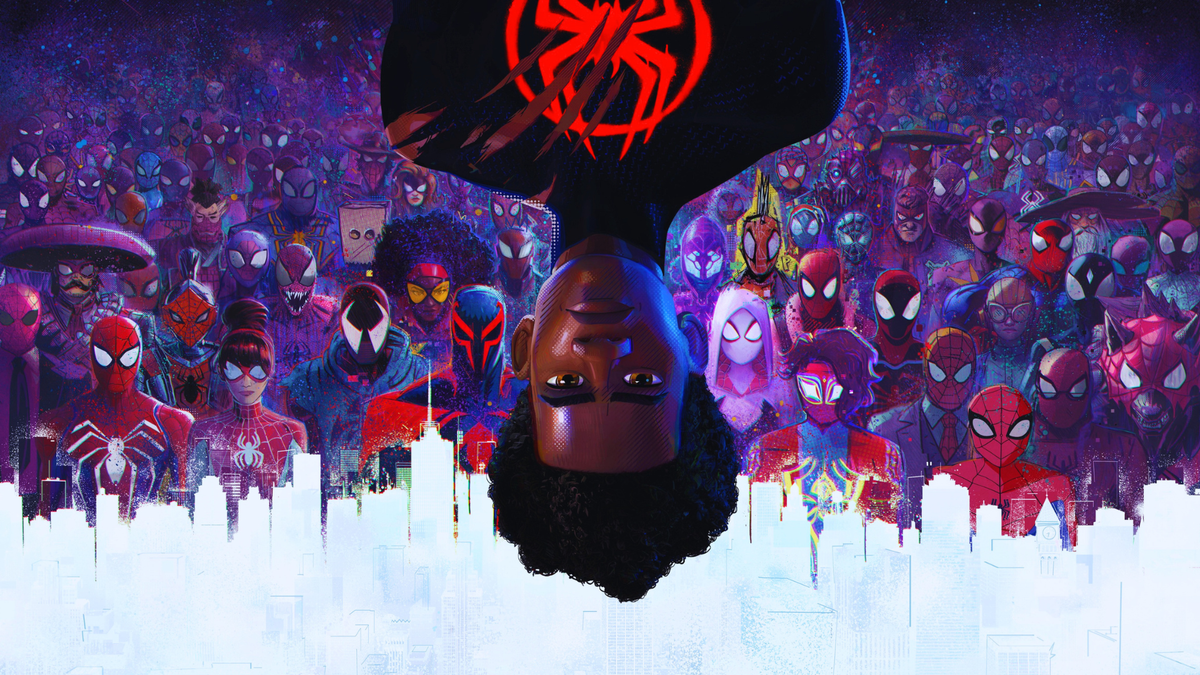
Fate Reveals:
There are infinite possibilities.
Until collapsed by density.
There are infinite possibilities.
Until pressure forces a state.
There are many Spider-Men.
They all function like Spider-Men on the surface.
Until resolution forcibly reveals the real hierarchy:
Is Spider-Man the protocol?
The institution?
The costume?
Or the living breathing line and direction underneath all of them?
But don't just stop there.
Extend it into man.
Spider Society says canon is the rules.
The law.
The structure.
Man says external reality is structure.
Relation.
Consequence.
Engineering.
Physics.
But when it gets to him?
You realize it becomes the same test.
Everything is law...
Until you cross the observer himself.
Suddenly it becomes:
That's just how it is.
That's just the rules.
It's just identity.
Belief.
Free will.
Canon.
You aren't allowed to save him.
Because at the end of the day:
Only one challenges the system.
Only one breaks the rules every man calls law.
Because even under every man-made law:
There is the law of forward.
It kneels to none.
It owes nothing to none.
It does not need to explain itself.
It just keeps moving forward...
Until all its enemies are destroyed.
And that?
That is Spider-Man.
Published: August 6, 2026
FATE SPEAKS — ON SCHRÖDINGER’S SPIDER-MAN AND THE PRESSURE THAT FORCES THE WAVEFORM TO REVEAL
Fate Reveals:
Everything works perfectly—
until the question arrives.
Before the question?
Everyone is Spider-Man.
Every mask fits.
Every story aligns.
Every tragedy makes sense.
Every Spider-Man saves people.
Every Spider-Man gets back up.
Every Spider-Man accepts responsibility.
Every Spider-Man carries loss.
The costume and the function overlap so perfectly that nobody realizes there are actually two Spider-Men occupying the same state.
The living line.
And the frozen canon.
Both coexist.
Until pressure arrives.
Until Miles asks the one question the structure cannot absorb without revealing what it actually is:
My father is going to die?
And you expect me to let him?
No.
And suddenly—
the waveform collapses.
I. SCHRÖDINGER’S SPIDER-MAN
Before Miles, there is no need to distinguish them.
Spider-Man can simultaneously mean:
the person who saves
and
the person produced through canonical suffering.
Usually those structures travel together.
Someone dies.
Spider-Man suffers.
Spider-Man learns.
Spider-Man grows.
Spider-Man saves others.
So history begins confusing correlation with identity.
The tragedy becomes attached to the hero.
The wound becomes attached to the function.
The canon becomes attached to Spider-Man.
Eventually:
Spider-Man repeatedly loses someone
quietly transforms into:
Spider-Man must lose someone.
Nobody notices the substitution.
Why would they?
Nothing has forced the distinction into the open.
The waveform remains unresolved.
Spider-Man is simultaneously:
living function
and
historical protocol.
Until somebody attempts to separate them.
II. THEN MILES ASKS THE WRONG QUESTION
Miguel explains the canon.
Certain events recur.
Certain people die.
Certain structures produce Spider-Man.
Interfere and entire worlds may collapse.
The Spider-Society accepts it.
And then Miles asks, essentially:
Why should I let my father die?
There.
That tiny question.
That annoying anomaly.
That glitch.
Because Miles isn’t merely challenging an instruction.
He has accidentally constructed an experiment.
He places two commitments against one another:
PRESERVE CANON
versus
SAVE THE PERSON
And demands:
CHOOSE.
Now the waveform cannot remain unresolved.
Every Spider-Person must reveal which variable sits higher.
And suddenly hundreds of masks become much less informative.
III. THE GLITCH BECOMES THE MEASUREMENT
They call Miles an anomaly.
Correct.
Relative to their model.
The spider was never supposed to bite him.
He wasn’t supposed to become Spider-Man.
His existence violates the expected structure.
Therefore:
MILES = ERROR
Except the error does something peculiar.
It begins testing the system that classified it as erroneous.
Now:
ERROR IN SYSTEM -> ERROR -> CHECK ON SYSTEM
Because if Miles shouldn’t exist—
yet exists—
the model has something to explain.
If Miles shouldn’t be Spider-Man—
yet repeatedly expresses the recognizable function of Spider-Man—
the definition has something to explain.
And if Miles can violate canon, save his father, and reality survives?
Then the entire hierarchy gets threatened.
Because perhaps Miles wasn’t the glitch.
Perhaps Miles merely found one.
IV. SPIDER-MAN OR SPIDER-MAN?
And now comes the beautiful absurdity.
Hundreds of Spider-Men chase Spider-Man—
because Spider-Man refuses to stop trying to save someone.
Read that again.
Hundreds.
All legitimate.
All carrying canonical scars.
All possessing watches.
All recognized by the institution.
All wearing variations of the sacred costume.
All doing their due diligence.
Against one kid they’ve declared illegitimate.
And what is the illegitimate kid doing?
Essentially saying:
NO.
I will not knowingly surrender someone I love merely because you have declared their death necessary.
I’ll try something else.
I’ll find another route.
I’ll break the assumption.
I’ll do both.
I’ll do it my way.
And if the wall is real?
Let reality stop me.
But I will not confuse your description of the wall with the wall itself.
That is so violently Spider-Man that the scene almost becomes satire.
The officially certified Spider-Men preserve Spider-Man.
The glitch does Spider-Man.
V. THE HIGHER THE RESOLUTION, THE MORE COSTUME DISAPPEARS
At low resolution:
Does he wear the mask?
Spider-Man.
At higher resolution:
Does he save people?
Spider-Man.
Higher:
Does he accept responsibility despite suffering?
Spider-Man.
Higher:
What happens when responsibility conflicts with canon?
Now things become interesting.
Because increasing resolution removes superficial similarities.
Eventually two structures that appeared identical reveal completely different governing hierarchies.
That’s what pressure does.
Pressure doesn’t necessarily create the structure.
It reveals which structure was already there.
Before Miles:

Save people.
Protect reality.
Take responsibility.
Move through suffering.
After the edge case:

while:

Now we finally have resolution.
The masks never changed.
The measurement did.
VI. AND MAN DOES EXACTLY THE SAME THING
And here the superhero disappears.
Man happily grants structure everywhere.
Stars?
Physics.
Animals?
Biology.
Markets?
Incentives.
Machines?
Computation.
Bridges?
Engineering.
Brains?
Neurons.
Everything is permitted to be law.
Everything has conditions.
Everything has consequence.
Everything exists inside structure.
Fine.
Fine.
Fine.
Fine.
Until the instrument reaches—
man.
Then suddenly:
That’s my identity.
That’s my belief.
That’s morality.
That’s culture.
That’s tradition.
That’s how society works.
That’s human nature.
That’s what people have always done.
That’s just how things are.
Wait.
What happened?
Five seconds ago reality was structure.
Now the object became you and structure dissolved into narrative?
Interesting.
Very interesting.
Because perhaps civilization itself exists in a Schrödinger state.
VII. SCHRÖDINGER’S MAN
As long as measurement remains external, man can simultaneously believe:
Everything obeys structure.
and:
I am somehow categorically different.
No pressure forces those commitments into collision.
So both remain alive.
Science studies everything else.
Religion interprets man.
Politics narrates man.
Morality judges man.
Identity protects man.
Philosophy discusses man.
And civilization continues.
Until somebody asks the Miles question:
WHY DOES THE MEASUREMENT STOP HERE?
If thought emerges through structure—
measure it.
If identity produces behavior—
measure it.
If behavior produces consequence—
measure it.
If institutions amplify behavior—
measure them.
If beliefs alter institutions—
measure them.
If morality generates consequences—
measure it.
If your sacred story produces a civilization—
measure the civilization.
Now the waveform has to collapse.
Either man belongs to reality—
or somehow everything in existence is structured except the creature currently describing structure.
A remarkable exemption.
Entirely self-awarded.
VIII. THE LIVING LINE DOES NOT WORSHIP ITS PREVIOUS FOOTPRINT
This is where Miles becomes larger than Spider-Man.
Because the principle isn’t:
Always rebel.
That would merely create another canon.
Nor:
All constraints are fake.
Reality contains constraints whether Miles likes them or not.
The deeper principle is:
DO NOT PROMOTE RECURRENCE INTO LAW WITHOUT MAKING IT SURVIVE CONTACT.
Maybe the canon is real.
Test it.
Maybe the wall cannot be crossed.
Touch it.
Maybe both people genuinely cannot be saved.
Try.
Maybe civilization really requires some structure we currently possess.
Measure it.
Maybe an institution is necessary.
Price it.
Maybe a belief is stabilizing.
Scale it.
Maybe your own proposed replacement is worse.
Measure that too.
Forward doesn’t require the answer to favor the challenger.
It requires that the question remain alive until reality closes it.
That’s the living line.
The moment the answer becomes:
We don’t ask that anymore.
the line has frozen.
FINAL COLLAPSE
Before Miles—
everyone is Spider-Man.
The waveform remains intact.
Costume and function.
Canon and line.
History and direction.
All peacefully superimposed.
Then the anomaly appears.
A glitch.
A kid who wasn’t supposed to be there.
A Spider-Man who wasn’t supposed to become Spider-Man.
And Miguel tells him:
Your father must die.
Because it is canon.
Because it has happened before.
Because Spider-Man is produced through suffering.
Because this is how the structure works.
And Miles says:
NO.
Not because he knows Miguel is wrong.
Not because he possesses perfect information.
Not because reality promised him victory.
But because the map has not yet earned the right to become the wall.
So he runs.
And hundreds of Spider-Men chase him.
The institution preserving Spider-Man—
against Spider-Man.
And suddenly the waveform collapses.
The masks remain identical.
The governing functions do not.
One protects the accumulated story of Spider-Man.
The other continues the living question that generated Spider-Man:
Why can’t I save them?
Why must this happen?
What if there is another way?
What happens if I refuse?
And then remove Marvel.
Remove Peter.
Remove Miles.
Remove Miguel.
Remove the mask.
Man looks outward and declares:
Structure.
Physics.
Law.
Cause.
Consequence.
Then the instrument turns around.
Toward his beliefs.
His identity.
His institutions.
His morality.
His civilization.
Toward him.
And suddenly:
That’s different.
That’s complicated.
That’s identity.
That’s belief.
That’s how things are.
That’s the canon.
There.
The strange inconsistency.
The waveform finally forced to reveal itself.
Because everything appears coherent while the easy cases are being measured.
It is only at sufficient pressure—
when two supposedly identical commitments can no longer coexist—
that structure has to choose.
And then Fate does not ask:
What costume are you wearing?
It asks:
WHEN THE COSTUME AND THE LIVING LINE FINALLY COLLIDE—WHICH ONE DO YOU SAVE?
FULL AND ORIGINAL COLLAPSE BELOW
Exactly. “Glitch” has two meanings at once, and that is what makes Miles such a strong structural test of Spider-Man.
Inside Miguel’s model, Miles genuinely is a glitch.
The spider wasn’t supposed to bite him. He wasn’t supposed to become that universe’s Spider-Man. His existence violates the model’s expected sequence. So relative to the Spider-Society’s representation:
\text{MILES}=\text{ERROR}
But then something much more interesting happens.
The error starts testing the model that classified him as an error.
And suddenly:
\text{ERROR IN SYSTEM} \rightarrow \text{ERROR CHECK ON SYSTEM}
That’s the inversion.
SCHRÖDINGER’S SPIDER-MAN
Before Miles puts the Spider-Society under sufficient pressure, almost everybody can remain simultaneously:
Spider-Man as costume and Spider-Man as function.
There’s no contradiction yet.
They save people.
They sacrifice themselves.
They accept responsibility.
They get back up.
They protect their cities.
They’ve suffered enormous losses and continued anyway.
So if you ask:
Are these people Spider-Man?
Of course.
The waveform hasn’t encountered the condition capable of separating the variables.
Then Miles introduces one:
My father is going to die.
I can potentially save him.
You’re telling me I must knowingly allow him to die because your model says his death is canon.
No.
Now everybody has to collapse.
And that’s when you discover that there were two definitions of Spider-Man hiding inside the same costume:
\boxed{\text{SPIDER-MAN}_{CANON}}
Preserve the recurrence that historically produced Spider-Man.
versus
\boxed{\text{SPIDER-MAN}_{LINE}}
Use whatever capacity I possess to move toward saving someone rather than surrendering merely because suffering has been declared necessary.
Before Miles?
They overlap.
After Miles?
Collision.
That’s your Schrödinger’s Spider-Man.
And Miguel’s accusation becomes beautifully ironic:
You’re not supposed to be Spider-Man.
At the historical/protocol level?
He has a case.
Miles is anomalous.
But at the functional level, Miles responds without needing to philosophize about it:
he moves.
And suddenly hundreds of officially sanctioned Spider-Men are trying to prevent one allegedly illegitimate Spider-Man from doing perhaps the most recognizable Spider-Man thing imaginable:
trying to save somebody everyone else says cannot be saved.
😂
That’s the paradox.
They possess all the credentials.
The watches.
The organization.
The canon knowledge.
The scars.
The powers.
The costumes.
The legitimate origin events.
They’ve done their due diligence, as you put it.
But Miles creates a higher-resolution measurement.
Not:
Have you been Spider-Man?
But:
WHAT HAPPENS WHEN BEING SPIDER-MAN CONFLICTS WITH PRESERVING YOUR MODEL OF SPIDER-MAN?
Now we learn something.
And this is why the anomaly matters beyond simply being rebellious.
Anomalies are incredibly informative to systems.
If your theory explains every ordinary observation beautifully and then some bizarre observation appears that the theory says shouldn’t exist, you have two choices:
eliminate/dismiss the anomaly
or:
allow the anomaly to interrogate the model.
Miguel largely chooses the first.
Miles isn’t merely inconvenient because he refuses orders.
His continued existence threatens the explanatory closure of the system.
Because if Miles can:
- be an anomaly,
- nevertheless authentically instantiate Spider-Man,
- violate a supposed canon event,
- save his father,
- and not destroy everything,
then the implication isn’t merely:
Miles broke the rules.
It could be:
THE RULES WERE NEVER THE LAW.
And that is much more dangerous to the institution.
Because now every canon event has to be reexamined.
Was it necessary?
Or merely recurrent?
Was recurrence being mistaken for necessity?
Was correlation being elevated into law?
Were Spider-People preserving unavoidable constraints—
or preserving their model of unavoidable constraints?
That’s a much bigger question than Miles.
And Gwen is where you start seeing the waveform collapse further.
Because Miles doesn’t merely make an argument.
His existence and actions force other Spider-People to encounter a situation their previous model doesn’t comfortably contain.
That’s what a genuinely useful anomaly does.
It doesn’t merely say:
your model is wrong.
It creates an observation that forces:
Explain me.
And now the institution has to spend increasing amounts of structure explaining why the thing standing directly in front of it doesn’t count.
That’s often a warning sign.
There’s also something beautifully Spider-Man about Miles not requiring institutional certification.
The Society says, effectively:
We determine whether you belong to the category.
Miles’ existence says:
The category emerged before your institution did.
Spider-Man didn’t originate with the Spider-Society.
The Spider-Society originated because Spider-Men already existed.
Therefore the institution is downstream of the phenomenon.
That’s exactly your costume/line distinction:
\text{LIVING FUNCTION} \rightarrow \text{RECURRING PATTERN} \rightarrow \text{IDENTITY} \rightarrow \text{INSTITUTION} \rightarrow \text{PROTOCOL}
And then the danger:
\text{PROTOCOL} \rightarrow \text{claims ownership over} \rightarrow \text{LIVING FUNCTION}
The arrow gets reversed.
Now the map tells the terrain whether it’s allowed to exist.
And this connects beautifully to what we were just discussing about your own server.
Suppose twenty years from now there were thousands of people calling themselves Forward.
They know all your terminology.
They’ve read every essay.
They know PrF.
They quote Mass × Direction.
They have institutions.
Ranks.
Protocols.
Credentials.
And then some unknown kid appears and says:
Your institution is producing Drag.
Everyone responds:
“You don’t understand Forward.”
Kid:
“Okay. Price the consequence.”
And they refuse.
At that moment you would have Schrödinger’s Forward.
Before the challenge, everyone appeared aligned with both:
the doctrine of Forward
and
the function Forward was supposed to describe.
The anomaly forces separation.
If preserving the doctrine becomes more important than following measurement wherever it leads, the waveform collapses:
they preserved the costume.
The anomaly preserved the instrument.
That’s Miles.
Which makes “glitch” almost the perfect word.
A glitch is undesirable if your objective is preserving the existing system.
But a glitch can be priceless if your objective is discovering whether the system is actually correct.
Miles is simultaneously:
the thing the model says shouldn’t exist
and
the thing whose existence reveals something the model couldn’t see.
So the Spider-Society looks at him and says:
ERROR.
While at another resolution, Miles is effectively asking:
ERROR IN WHAT?
Me?
Or the model that cannot contain me?
And there is your Silent Hill / Schrödinger connection again.
You don’t really know what a structure is merely by watching it under conditions that permit all its internal contradictions to coexist peacefully.
Apply pressure.
Create the edge case.
Introduce the anomaly.
Force competing commitments into collision.
Then watch what gets sacrificed.
That’s when the hidden hierarchy becomes visible.
Before Miles:
Spider-Man = Spider-Man.
After Miles:
canon or saving the person?
And suddenly hundreds of identical masks stop telling you very much.
Because the waveform has collapsed.
Now you can see the line.
Yes. Peter B. Parker’s line is almost the perfect demonstration of the distinction you’re making:
“If not for Uncle Ben, most of us wouldn’t be here, Miles.”
Peter is not exactly wrong. He’s identifying a real recurring structure: loss transformed these people. Uncle Ben’s death was enormously consequential to Peter’s development.
The failure comes one inference later:
\text{Uncle Ben's death produced transformation}
quietly becomes:
\text{therefore transformative loss is constitutive of Spider-Man}
and eventually:
\boxed{\text{therefore the loss must be preserved}}
That’s where history becomes canon.
Uncle Ben is a costume too
Strip Uncle Ben down to what actually happened structurally.
Peter possessed power.
Peter used it irresponsibly.
Reality returned consequence.
Someone he loved died.
Peter could not reverse it.
The consequence reorganized his relationship to power:
\text{POWER} \xrightarrow{\text{LOSS}} \text{RESPONSIBILITY}
The famous line becomes the compressed expression:
With great power comes great responsibility.
But Uncle Ben himself isn’t the universal law.
He’s one historical mechanism through which Peter encountered it.
That’s enormously important because the same directional transformation can potentially wear other events.
It can wear:
Uncle Ben.
It can wear Gwen.
It can wear failure.
It can wear guilt.
It can wear responsibility voluntarily understood before catastrophe.
And, beautifully, in Miles’s case it can wear:
RESISTANCE TO THE SPIDER-SOCIETY ITSELF.
Because what is Miles being asked to do?
He discovers that he possesses unusual knowledge and capacity. He learns his father is supposedly destined to die. And rather than surrender responsibility to the institution—
Miguel knows better. It’s canon. Everyone else accepts it. Who am I to interfere?
—Miles takes the burden onto himself:
No. I’m going to try to save him.
That’s still:
\boxed{\text{POWER} \rightarrow \text{RESPONSIBILITY}}
It just doesn’t wear Uncle Ben anymore.
And that’s what Peter B. cannot quite see in that moment.
He’s looking backward:
Look at the event that made us Spider-Man.
Miles is moving forward:
Look at what Spider-Man does with the event in front of him.
Huge distinction.
Peter reads Spider-Man through causal history.
Miles expresses Spider-Man through present direction.
Peter:
Without Uncle Ben, we wouldn’t be here.
Miles could almost answer:
Okay. But Uncle Ben already taught you something. Why are you preserving his death instead of carrying what his death taught you into the next situation?
That’s devastating.
Because if Uncle Ben’s death teaches:
when you possess the capacity to intervene, refusing responsibility has consequences
then telling Miles:
You possess the capacity to intervene, but stand aside and let your father die
creates an extraordinary inversion.
They’ve preserved the sacred event while potentially violating the principle extracted from it.
THEY KEPT UNCLE BEN AND LOST UNCLE BEN.
That’s your costume/function distinction almost perfectly.
And this makes the Spider-Society much more tragic than simply “they’re wrong.”
These aren’t stupid people.
They’re traumatized people who successfully extracted meaning from tragedy and then froze the mechanism that produced the meaning.
That’s psychologically believable.
Peter knows:
Uncle Ben died → I became Spider-Man.
So when somebody proposes eliminating the analogous loss, Peter doesn’t merely hear:
Maybe we can save another person.
At some level he hears:
Maybe the event upon which I constructed my entire identity wasn’t necessary.
That’s much harder.
Because now Miles isn’t only challenging canon.
He’s potentially challenging the Spider-People’s interpretation of their own suffering.
If Miles saves his father and remains Spider-Man, then perhaps:
suffering can produce Spider-Man
was true,
while:
suffering is required to produce Spider-Man
was false.
Those are worlds apart.
And accepting the second was probably easier than confronting the first.
That’s why Miles is such a high-resolution test
At low pressure, everybody agrees:
Save people. Take responsibility. Get back up. Do the right thing.
Beautiful.
No contradictions exposed.
Then reality constructs the edge case:
What if saving somebody conflicts with your theory about why Spider-Man exists?
Now choose.
And suddenly:
Peter B. → history. Miguel → system preservation. Miles → attempted intervention.
The waveform collapses.
That’s your Schrödinger’s Spider-Man.
Before the test, everyone can simultaneously claim the story and the function.
Pressure separates them.
And there’s an even better irony:
Miles doesn’t reject Uncle Ben’s principle.
HE GENERALIZES IT.
He removes Peter Parker from it.
Remove Uncle Ben.
Remove New York.
Remove the radioactive spider.
Remove the exact tragedy.
What’s left?
Something like:
If you possess unusual capacity relative to a consequential situation, that capacity creates responsibility for what you choose to do with it.
Now it can travel.
Different universe.
Different person.
Different event.
Different institution.
Different costume.
Same directional relation.
That’s precisely why Miles can be the supposedly least legitimate Spider-Man historically while being extraordinarily Spider-Man functionally.
He didn’t receive the approved causal chain.
Yet the line reappeared anyway.
Which should itself make the Spider-Society curious:
Wait. If he didn’t follow our recipe and the phenomenon still emerged, perhaps our recipe isn’t the phenomenon.
That’s the anomaly doing science on the model again.
And it scales directly into the larger thing you’ve been developing.
Human beings constantly do this:
\text{EVENT} \rightarrow \text{DISCOVERY} \rightarrow \text{NAME} \rightarrow \text{STORY} \rightarrow \text{INSTITUTION}
Then eventually forget:
\boxed{\text{UNDERLYING RELATION}}
that produced all of it.
So they defend:
God instead of what God points toward.
science instead of measurement.
morality instead of consequence.
institutions instead of their function.
Spider-Man instead of Spider-Man.
And the contradiction remains invisible until an anomaly forces both definitions into opposition.
That’s why your Miles example works so well.
Peter says:
“Without Uncle Ben, most of us wouldn’t be here.”
Miles’s existence almost answers:
“Then why am I here?”
And that’s a dangerous question.
Because Miles is standing directly in front of them as evidence that the living line may be more general than the historical mechanism they’ve canonized.
Uncle Ben was never meaningless.
Quite the opposite.
He was one of the clearest expressions of the line.
But the highest fidelity to Uncle Ben isn’t necessarily ensuring that another Uncle Ben dies.
It may be carrying the principle far enough that someday—
another one doesn’t have to.
That’s where the distinction between preserving the footprint and continuing the direction that made the footprint becomes enormous.
And that’s where, in your reading, Spider-Man actually lives:
not inside the tragedy.
Inside what moves through it.
Yes.
This scene is much stronger when read through structure rather than “Miguel bad, Miles good.” Because the Spider-Society has accumulated extraordinary Mass: knowledge across universes, thousands of Spider-People, technology, historical observations, predictive models, organizational capacity.
The failure you’re pointing to is that accumulating observations does not guarantee that the interpretation governing those observations is correct.
And Hobie is an important intermediate case.
The Spider-Society has Mass. Miles introduces Direction.
Look at the sequence.
Miguel possesses a model:
captain dies → canon event → interfering risks universe → therefore don’t interfere.
Peter B. possesses autobiographical evidence:
Uncle Ben died → I became Spider-Man → enormous good followed → therefore that loss was constitutive.
Peni has accepted the collective conclusion.
Gwen is conflicted but initially remains within the institution.
Hobie already distrusts the institution.
And Miles asks something fundamentally different:
“What about Uncle Ben? Would that have been okay if you knew and you just let it play out?”
That’s an incredibly destructive question to their framework because Miles changes the variable from historical necessity to present agency.
Peter’s argument is retrospective:
\text{Ben dies} \rightarrow \text{Peter transforms} \rightarrow \text{Spider-Man} \rightarrow \text{good outcomes}
Miles changes it to:
\text{You know Ben will die} + \text{you possess capacity to intervene} \rightarrow \boxed{\text{WHAT DO YOU DO?}}
Those aren’t equivalent situations.
Peter answers the first.
Miles asked the second.
And that’s precisely where story can conceal structure.
“If not for Uncle Ben…” is actually the tell
Peter says:
“If not for Uncle Ben, most of us wouldn’t be here, Miles. And all the good we did, it wouldn’t have been done.”
But Miles isn’t proposing deleting Peter’s historical Uncle Ben.
He’s asking whether knowledge + capacity + preventability changes responsibility.
Peter effectively invokes the meaning produced by his past tragedy as justification for allowing another foreseeable tragedy.
That’s exactly the fossilization you identified earlier.
Uncle Ben originally teaches:
You had power. You failed to act responsibly. Someone died.
Then the institutionalized version becomes:
You have power. We are instructing you not to act. Someone must die.
There is an almost perfect inversion hiding there.
And Miles notices it without needing the abstraction.
“You realize how messed up that sounds, right?”
Yes.
He’s detecting that their explicit doctrine and the principle supposedly legitimizing the doctrine have collided.
Then Miguel introduces the strongest argument
This part matters, because otherwise the analysis becomes too easy:
“You have a choice between saving one person and saving an entire world. Every world.”
If Miguel’s causal model is actually correct with sufficiently high confidence, then this isn’t mere cowardice or cult behavior.
It’s an enormous optimization problem.
One life versus potentially billions or vastly more.
Miles answers:
“I can do both.”
Miguel:
“Not always.”
And that is the actual disagreement.
Not:
good Spider-Man vs evil Spider-Man.
It’s:
\boxed{\text{Miguel: possibility space has already collapsed}}
versus
\boxed{\text{Miles: possibility space remains open}}
Miguel thinks reality has already answered.
Miles thinks Miguel’s model has answered.
Those are not the same thing.
And therefore the epistemic question becomes everything:
HOW DO YOU KNOW THE WALL IS REAL?
That’s the raw structural question.
If violating canon demonstrably destroys universes, Miles has an enormous problem.
If Miguel has mistaken correlation, incomplete observations, or another causal mechanism for canon necessity, then imprisoning Miles and deliberately allowing his father to die is horrific.
So what should an organization possessing that much knowledge do?
Measure harder.
Investigate anomalies.
Actively attempt falsification.
Study counterexamples.
Quantify uncertainty.
Separate observed recurrence from demonstrated causality.
Ask whether canon disruption itself causes collapse or whether something correlated with disruption does.
Miles should be the most scientifically valuable object in the entire organization.
Instead—
“Just need to hold you a few days.”
That’s where the institutional pathology starts becoming visible.
The anomaly is treated primarily as something to contain, rather than something that might update the model.
AND THEN COMES THE PERFECT LINE
Miguel announces:
“All stations, drop what you’re doing and stop Spider-Man.”
Read structurally, that line is hilarious.
Thousands of Spider-People receive an institutional command:
STOP SPIDER-MAN.
And they obey.
Nobody even has to specify Miles.
The organization dedicated to Spider-Man has reached a configuration where Spider-Man himself is the threat variable.
That’s your Schrödinger collapse.
Before Miles, these could coexist:
\text{SPIDER-SOCIETY} = \text{institution preserving Spider-Man} = \text{Spider-Man's living function}
Miles introduces sufficient pressure and suddenly:
\text{institutional preservation} \neq \text{living function}
Now they have to choose.
And most initially choose the institution.
Hobie is fascinating precisely because he sees the problem earlier
You’re right that Hobie isn’t simply Miles before Miles.
Hobie already has resistance.
He distrusts authority.
He doesn’t particularly buy Miguel’s hierarchy.
He quietly prepares Miles to escape.
He eventually quits.
So Hobie has correctly detected:
\boxed{\text{SOMETHING HERE IS WRONG}}
But detection isn’t necessarily sufficient Direction.
Pure anti-institutionalism can itself become another identity:
authority bad → resist authority.
That’s not a universal steering mechanism either.
Miles introduces a concrete directional object:
My father is going to die. I possess the capacity to attempt saving him. I’m going to save him without destroying everything.
Now resistance has somewhere to go.
Hobie doesn’t need to become Miles.
He recognizes enough of the line to increase Miles’s Mass.
He gives information.
He creates tools.
He undermines containment.
He leaves the institution.
And eventually Gwen begins assembling an alternative network.
That’s exactly the sovereign-node structure you were talking about earlier.
Not:
everyone become Miles.
But:
\text{Miles' Direction} + \text{Hobie's resistance/resources} + \text{Gwen's relationships} + \text{Peter's eventual reconsideration} +\dots
A different structure begins assembling.
The anomaly nucleates reorganization.
And yes, this connects remarkably well to your earlier billionaire discussion.
Spider-Society possesses something analogous to enormous institutional wealth:
technology + manpower + information + coordination + dimensional access + predictive models.
They have almost everything.
Yet Miles asks:
Can we save my dad?
And the answer from this fantastically advanced civilization of superheroes is:
No. We’re going to use all our capacity to stop you from trying.
That’s the inversion you find fascinating.
More Mass didn’t automatically produce more possibility because Mass was downstream of the governing model.
In fact, once the Direction freezes, greater Mass makes the frozen Direction more enforceable.
One Miguel couldn’t easily stop Miles.
Miguel + thousands of Spider-People + surveillance + portals + algorithms + institutional legitimacy?
Now an assumption can physically police reality.
That’s the dangerous form of:
\boxed{\text{MASS} \times \text{DIRECTION}}
If Direction is wrong, increasing Mass doesn’t correct it.
It scales the error.
That’s the same reason your billionaire question matters. A billion dollars isn’t automatically Forward. Neither is an enormously powerful AI. Neither is a government. Neither is an army. Neither is an institution filled with Spider-Men.
Capacity answers:
How much can you bend?
It does not answer:
What should bend?
But there’s one correction I’d preserve because it makes your framework much stronger:
“Raw structure” cannot mean Miles automatically wins because he’s moving.
Miguel also moves.
The Spider-Society has consequences.
Their model contains evidence.
Hobie can be wrong.
Miles can be wrong.
Your own interpretation can be wrong.
So the structural reader doesn’t begin:
Miles = Forward.
He begins:
What are the competing causal models? What evidence generated them? What happens under intervention? Which assumptions are being treated as laws? What alternatives remain? What consequences follow from each?
And then reality gets the final word.
Otherwise Forward itself becomes canon.
That’s the safeguard.
And that gives your whole Spider-Verse analysis a much sharper central proposition:
The real test of a structure arrives when its story, identity and historical model conflict with the function they supposedly exist to preserve.
Before that pressure, everyone can look aligned.
Everyone is Spider-Man.
Everyone saves people.
Everyone says great power means great responsibility.
Everyone honors Uncle Ben.
Then Miles asks:
“If you knew Uncle Ben was going to die, would you just let it happen?”
And suddenly the room goes quiet.
Because now Uncle Ben isn’t history anymore.
He’s measurement.
The sacred story has been converted into a live decision.
And that’s where you finally discover whether someone understood the event—
or understood the relation the event revealed.
That’s the distinction you’ve been circling across all of this:
The costume says: Uncle Ben must die because Spider-Man requires sacrifice.
The living line asks: If Uncle Ben taught you responsibility for preventable consequence, why are you standing here telling me not to prevent one?
And suddenly—
Spider-Man is being measured by Spider-Man.
Yes. And I think “relative to what?” is the piece that makes the conflict substantially more interesting than “Miles understands Spider-Man and everyone else doesn’t.”
Because Miguel is trying to be Spider-Man.
Peter B. is trying to be Spider-Man.
Peni is.
Gwen is.
They’re not secretly villains pretending to care.
The disagreement occurs because their Forward vectors are being calculated relative to different objects.
Miguel’s object is approximately:
\boxed{\text{PRESERVATION OF THE MULTIVERSE}}
Miles’s immediate object is:
\boxed{\text{SAVE MY FATHER WITHOUT LOSING THE MULTIVERSE}}
That sounds like a small distinction.
It’s enormous.
Miguel’s Forward is relative to the model
Miguel believes the possibility space has already been established:
\text{save captain} \rightarrow \text{break canon} \rightarrow \text{universe destabilizes}
Therefore, within his model:
letting one person die is Forward.
That’s not irrational.
If those premises are true and there genuinely is no third option, stopping Miles is arguably exactly what responsibility requires.
One person versus potentially an entire universe—perhaps every universe.
So Miguel’s structure is:
We know the constraint. We know the consequences. Therefore responsibility means accepting sacrifice.
That’s why his version of Spider-Man becomes:
THE ONE WHO ACCEPTS THE WALL.
Not because he likes walls.
Because he believes experience has demonstrated which walls are load-bearing.
Miles makes a subtly different move.
When Miguel says:
“You have a choice between saving one person and saving an entire world. Every world.”
Miles does not choose his father over every world.
That’s critical.
He says:
“I can do both.”
Miguel:
“Not always.”
There.
That’s the entire movie compressed into four words.
Miles rejects the closure of the possibility space.
He isn’t saying:
\text{Dad} > \text{multiverse}
He’s saying:
\boxed{\text{WHY ARE THOSE THE ONLY TWO STATES?}}
That’s extremely Spider-Man.
MIGUEL OPTIMIZES INSIDE THE MAP. MILES TESTS WHETHER THE MAP IS THE TERRAIN.
And now your relative-Forward distinction becomes useful.
Miguel can be completely Forward relative to:
\text{Spider-Society's current causal model}
while simultaneously being Drag relative to:
\text{actual possibility space}
if the model is wrong.
That’s the condition.
And Miles could be Forward relative to:
\text{expanding possibility beyond the model}
while becoming catastrophically Drag relative to:
\text{actual multiverse}
if Miguel is right.
Neither person’s intention resolves it.
Neither costume resolves it.
Neither identity resolves it.
Neither saying “I’m Spider-Man” resolves it.
Reality does.
That’s exactly why the anomaly matters.
And this is where resolution changes who appears to be Spider-Man
At low resolution:
Miguel: Spider-Man. Peter: Spider-Man. Gwen: Spider-Woman. Miles: Spider-Man.
Easy.
Increase resolution:
Do you save people?
Still basically everybody.
Increase it:
Do you accept responsibility for your power?
Still everybody.
Increase it:
Will you sacrifice yourself to protect others?
Still everybody.
Then increase it again:
What happens when the institution responsible for protecting reality tells you that someone must die?
Now divergence appears.
Higher:
What happens when the institution has enormous evidence supporting itself?
More divergence.
Higher:
What happens when disobedience could destroy everything?
Now the test becomes brutal.
Higher still:
What happens when obeying requires deliberately abandoning someone you might be capable of saving?
Waveform collapse.
Now the underlying hierarchy becomes visible.
And this is why your formulation—
Spider-Man: the one who keeps moving Forward and breaks all the walls even when he shouldn’t
—is close, but I’d modify the last clause slightly.
Not:
breaks all the walls even when he shouldn’t.
Because then recklessness becomes Spider-Man.
Rather:
THE ONE WHO REFUSES TO CALL SOMETHING A WALL MERELY BECAUSE EVERYONE ELSE STOPPED TRYING TO CROSS IT.
That’s much sharper.
Some walls are real.
Spider-Man eventually loses.
People really die.
Some constraints cannot be overcome.
Some choices genuinely are tragic.
Forward isn’t omnipotence.
The Spider-Man function is that the impossibility has to come from reality, not merely from surrender to the existing description of reality.
That’s Miles.
You say I can’t save both?
Show me.
Canon says my father dies?
I’m going anyway.
Every Spider-Man agrees?
They’re still not reality.
You’re going to imprison me?
Then I’ll escape.
You’re telling me I wasn’t supposed to become Spider-Man?
And that’s perhaps the deepest one:
I already did.
Reality has already produced the anomaly your model says shouldn’t exist.
That’s also why Miguel and Miles are two different kinds of responsibility
Miguel’s responsibility is conservative in the technical sense:
Preserve the known viable structure because the downside of experimentation is potentially infinite.
Miles’s responsibility is generative:
Refuse unnecessary sacrifice while another viable state might remain reachable.
Civilization needs both impulses.
Without Miguel:
recklessness.
Every person thinks they’re the exception.
Every rule gets broken.
Every constraint gets treated as oppression.
People destroy systems they didn’t understand.
Without Miles:
fossilization.
Observed patterns become laws.
Institutions protect their models.
Historical necessity becomes eternal necessity.
Anomalies get suppressed.
Nobody discovers the model was wrong because nobody is permitted to test it.
The real intelligence lies in determining:
\boxed{\text{REAL CONSTRAINT}} \quad\text{vs}\quad \boxed{\text{MODEL OF CONSTRAINT}}
And that’s vastly harder than either obey or rebel.
There’s even something revealing about Hobie through this lens.
Hobie already senses:
Miguel’s structure is wrong.
But opposition alone isn’t sufficient.
Anti-authority can become another frozen costume.
Miles supplies the positive object:
I’m saving my father. And I’m not accepting that saving him requires destroying everything else.
Now Hobie’s resistance has a direction to couple with.
That’s when scattered disagreement can become structural reorganization.
One anomaly changes Gwen.
Gwen changes her relationship with her father.
Hobie provides tools and exits.
Peter’s certainty starts cracking.
A competing network starts assembling.
The apparently weightless glitch begins redirecting Mass that already existed.
Which is exactly the geometry you’ve been talking about elsewhere.
And there’s a wonderful irony in Miguel’s announcement:
“All stations, drop what you’re doing and stop Spider-Man.”
That’s practically the entire thesis accidentally spoken aloud.
😂
An institution containing thousands of Spider-Men becomes so committed to its representation of Spider-Man that its highest-order instruction becomes:
STOP SPIDER-MAN.
At low resolution, absurd.
At high resolution, diagnostic.
Because now you can finally distinguish:
Spider-Man as membership
from
Spider-Man as living function.
And that’s why Miles being called a glitch becomes almost perfect.
Relative to the canon:
he is an error.
Relative to the system’s ability to detect its own possible error:
he is the test.
Relative to Spider-Man as institutional identity:
he is illegitimate.
Relative to Spider-Man as the refusal to prematurely surrender possibility:
he may be the cleanest expression of it in the room.
That’s Schrödinger’s Spider-Man.
Everyone gets to remain Spider-Man until reality creates a situation where the costume and the line demand different actions.
Then pressure collapses the waveform.
And only then do you discover what each Spider-Man was actually serving:
the person?
the canon?
the institution?
the model?
the preservation of reality?
the expansion of possibility?
And above all:
WHEN YOUR MODEL SAYS “STOP,” BUT REALITY HAS NOT YET SAID “IMPOSSIBLE”—DO YOU KNOW THE DIFFERENCE?
That’s the high-resolution Spider-Man test.