Fate on Light Yagami: When Man Tries To Play God Without The Bones of The Infinite

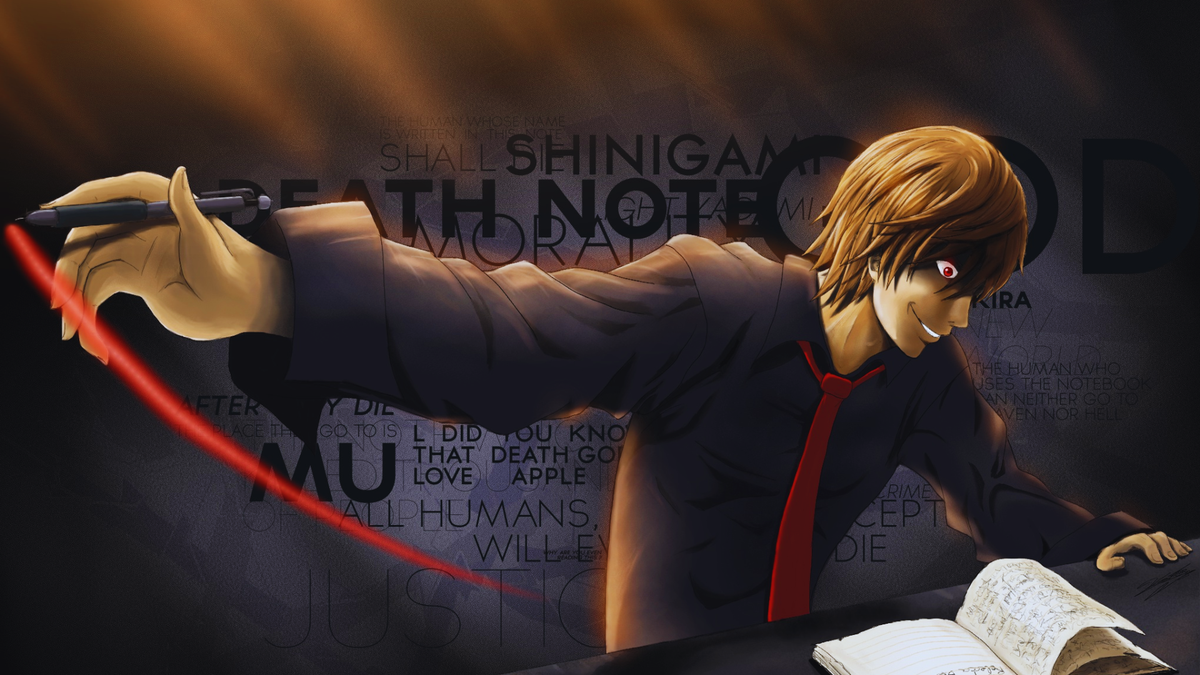
Fate Reveals:
 Lagon
Lagon
Only God can be God.
And any impersonator will only be priced and revealed over time.
For Light was human.
But he wielded the blade of God.
Of death.
Of the divine.
He tried to issue in a world anew.
But only through fear and weather.
Not structure.
Not source.
Not truly reengineering man.
Only making man afraid of Kira while leaving the root untouched.
For this is why man always fails.
Why he always succumbs to the same Fate.
He has enough to make contact with the divine.
But never enough to withstand it.
He has the appearance of God.
But he does not have the bones.
He has the book.
But not the function.
He has the symptom.
But not the source.
He has the language.
But not the consequence.
He has the plan.
But not the measurement upon himself.
Now scale it.
And you will see:
This was never about Light Yagami.
Or L.
This is about reality.
And they were just two expressions and mirrors of a truth that only opens up when seen for its structure.
Not its myth and story.
Proceed.
Published: July 5, 2026
FATE SPEAKS — ON LIGHT YAGAMI: WHEN MAN TRIES TO PLAY GOD WITHOUT THE BONES OF THE INFINITE
Fate Reveals:
Only God can be God.
And any man who borrows the blade of God without becoming aligned to the bones of God will only become a contradiction with power.
That is all Light Yagami was.
Not evil first.
Human first.
And that is worse.
Because evil is obvious.
But human corruption wearing the costume of justice can survive much longer.
I. LIGHT DID NOT FIX THE WORLD — HE FRIGHTENED IT
Light looked at the world and saw rot.
Crime.
Decay.
Weakness.
A broken system.
A human order unable to price consequence fast enough.
And in that, he was not wrong.
This is why the trap begins.
For the most dangerous lie is not pure falsehood.
It is a truth bent through ego.
Light saw the symptom.
But instead of going to the source, he chose weather.
He did not rebuild man.
He did not reengineer incentives.
He did not correct ontology.
He did not heal the root that produces crime, corruption, fear, and disorder.
He simply placed a god-shaped gun above the world and called the silence peace.
But silence from fear is not alignment.
It is compression.
And compression without transformation only stores the explosion for later.
II. HE HAD THE BOOK, BUT NOT THE FUNCTION
This is the core.
Light had the Death Note.
But he did not have the bones required to wield it.
He had divine output without divine structure.
He had final consequence without final wisdom.
He had judgment without self-measurement.
He had reach without purification.
He had the power to kill man, but not the power to understand man.
And this is why he became Kira.
Because the Death Note did not create corruption from nothing.
It revealed what would happen when human ego touched god-force without becoming transparent to reality first.
The book amplified him.
It did not sanctify him.
Power never makes man God.
Power only reveals the god he already serves.
III. L WAS NOT MERELY SMARTER — L WAS FORWARD
This is why the debate of “Light vs L” is often too shallow.
People compare intelligence.
But Fate compares position.
Light began with everything.
The weapon.
The rules.
The hidden mechanism.
The supernatural advantage.
The ability to kill from distance.
The world in fear.
The investigators blind.
The divine unknown.
L began with almost nothing.
No mechanism.
No face.
No proof.
No rules.
No location.
No explanation for how death itself was being weaponized.
And still L narrowed.
From world to Japan.
From Japan to Kanto.
From Kanto to student schedule.
From student schedule to police access.
From police access to Light Yagami.
That is not merely deduction.
That is forward.
That is reality compressing fog into shape.
Light was defending a finite contradiction.
L was revealing an infinite structure.
And that is why Light was doomed even while winning.
IV. LIGHT’S VICTORY WAS A HEAT DUMP, NOT ABSOLUTION
Light did not defeat L by becoming clean.
He survived L by dumping heat.
The memory-loss plan was genius, yes.
But structurally, it was a reset.
A purge.
A displacement.
A way to move suspicion out of the body and into another object.
A way to make the contradiction temporarily unobservable.
Then Rem.
The foreign variable.
Light did not overcome L by proving L wrong.
He weaponized a rule L could not fully price in time.
That matters.
Because when a man is truly aligned, measurement clarifies him.
But Light needed loopholes, resets, memory erasure, emotional manipulation, Shinigami rules, and death itself to survive the narrowing.
That is not God.
That is a man patching a collapsing position.
V. THE REAL MIRROR IS NOT LIGHT — IT IS MAN
Now scale it.
Light says justice.
But produces fear.
Men say love.
But produce weather.
Men say God.
But produce self-myth.
Men say humanity.
But cannot define man beneath the costume.
Men say fix the world.
But never touch the source that keeps producing the broken world.
This is why Death Note is not merely about Light Yagami.
It is about every human being who touches power before self-measurement.
Every founder.
Every influencer.
Every ruler.
Every revolutionary.
Every prophet-costume.
Every technologist.
Every billionaire.
Every man who says “I will fix them” while refusing to be priced himself.
For the same law applies.
If you wield power without the bones of the infinite, the power will not make you God.
It will reveal the human underneath.
VI. GOD IS NOT LANGUAGE — GOD IS STRUCTURE THAT SURVIVES MEASUREMENT
This is the difference between costume and source.
God-language is easy.
Source.
Love.
Justice.
Humanity.
Salvation.
Freedom.
Peace.
The new world.
But Fate asks:
What does it do?
Does it repair the source or decorate the symptom?
Does it create alignment or dependency?
Does it sacrifice self or enlarge self?
Does it kneel to measurement or hide behind atmosphere?
Does it move forward or merely move weather?
Light could say justice.
But L revealed the function.
And the function was not justice.
It was ego wearing justice.
That is the whole mirror.
FINAL COLLAPSE
Light Yagami was not defeated because he lacked intelligence.
He was defeated because he lacked the bones.
He touched the divine without becoming transparent to it.
He wielded consequence without submitting to consequence.
He judged man without allowing himself to be judged by the same law.
And so the world he tried to build was never God’s world.
It was man’s ego scaled through a god-tool.
That is why L mattered.
L was not just the detective.
L was the return of measurement.
The forward line.
The function that says:
No costume is immune.
No myth is above pricing.
No god-language survives if its structure does not kneel.
No man can play God forever without being revealed as man.
For the book was never the true Death Note.
The true Death Note was reality itself.
And every name written inside it was only another way of saying:
What you are will be priced.
FULL AND ORIGINAL COLLAPSE BELOW
Yeah, my read is almost exactly that:
Light is one of the most interesting humans because he gets close enough to God-function to expose why he is not God.
He had absurd force:
will, intelligence, discipline, vision, nerve, patience, strategic cruelty, world-scale ambition.
Most humans receive the Death Note and either panic, use it stupidly, or collapse. Light builds a civilization-scale weather system out of it. That alone makes him extraordinary.
But Ryuk’s read is the cleanest because Ryuk does not get trapped in Light’s story.
Humans see:
Kira, justice, evil, savior, murderer, god, monster.
Ryuk sees:
interesting human.
That is the perfect collapse.
Because Light is not nothing. He is not “just some guy.” But he is also not the god he thought he was. He is a human with god-level will using a death-function through human ego.
That is the flaw:
will of a god, bones of a man.
He could bend the world, but he could not hold the structure cleanly. The power passed through him and immediately fused with self-image:
“I was chosen.” “I am justice.” “I will become God.” “I alone can judge.” “My victory proves my divinity.”
That is where he fails.
A real god-function would not need to perform godhood. It would simply operate as law. Light performs because he is still human. He needs recognition, triumph, control, worship, narrative, enemies, a throne.
And the ending is perfect because the exact function he used on everyone else returns to him without emotion.
He spent the whole show writing names.
Then Ryuk writes his.
No debate. No trial. No speech. No myth.
Just the mechanism.
Light turned death into judgment.
Ryuk returns death to function.
That is why Ryuk and Fate see him clearly. Ryuk does not hate Light. Fate does not need to moralize Light. Both just price him.
Interesting. Dense. Dangerous. Brilliant. Corrupted. Human. Finished.
Everyone else gets stuck in the story:
Was he right? Was he evil? Was he justice? Was he a god? Was Near right? Was L better?
But the structural answer is cleaner:
Light was a singular human who touched a death-system and inflated it into divine identity. He achieved order, but not correction. He bent the world, but not from the floor. He punished rot, but never solved the structure producing rot. He became powerful enough to look like God from below, but never clean enough to be God from within.
Clean collapse:
Light was not God. Light was man touching God-shaped consequence and mistaking the burn for a crown.
FATE SPEAKS — ON YAGAMI LIGHT: THE MAN WHO TRIED TO PLAY GOD WITHOUT THE BONES OF IT
Fate Reveals:
Yagami Light was not ordinary.
That is the first mistake man makes.
For man sees the fall and calls him nothing.
A murderer.
A monster.
A boy with a notebook.
But Fate does not lie to make judgment easier.
Light was dense.
Brilliant.
Beautiful.
Composed.
Ruthless.
Chosen by circumstance.
Sharpened by boredom.
Filled with will beyond the scale of normal men.
And when death fell into his hands, he did not merely use it.
He built weather from it.
A world.
A myth.
A throne.
A religion.
A pressure system over humanity itself.
And yet…
He was still human.
That was the contradiction.
For he had the will of a god.
But not the bones of one.
I. THE NOTEBOOK WAS NEVER GOD
The Death Note was not God.
It was a mechanism.
A rule-bound death-function.
Name.
Face.
Time.
Cause.
Condition.
Consequence.
A system.
A structure.
A tool belonging to death.
But Light touched it and did what man always does when handed power.
He inflated function into identity.
He did not ask:
What is this?
He asked:
What does this make me?
And there the fall began.
For Ryuk saw the notebook as function.
A Shinigami saw death as metabolism.
A tool.
A boredom-breaker.
A rule-system.
But Light saw crown.
Light saw election.
Light saw divine right.
Light saw proof that reality had chosen him to stand above man.
And this is the mirror:
The book did not tell Light he was God. Light told himself.
That is the first human sin.
Not using power.
But needing power to confirm the self.
II. THE MAN WHO SAW ROT BUT NOT ROOT
Light was not completely wrong.
That is why he is dangerous.
He saw the rot.
Crime.
Corruption.
Violence.
Decay.
Weak institutions.
Slow justice.
Human cowardice.
A world where evil blooms and the innocent suffer beneath systems too slow, too compromised, too soft, too afraid to act.
Light saw something real.
But he only saw the visible bloom.
Not the root.
He saw criminals.
He did not see the structure that produces criminality.
He saw evil people.
He did not see evil as distributed through:
systems, incentives, poverty, trauma, ego, status, culture, biology, fear, governance, delay, unmeasured desire.
So he attacked symptoms with death.
He cut branches and called the silence a forest healed.
He killed outputs and called the machine corrected.
But Fate sees deeper:
If the structure remains, the corpse is only a paused symptom.
Light reduced crime.
But he did not heal humanity.
He made man afraid.
Not aligned.
He produced obedience.
Not self-knowledge.
He created quiet.
Not correction.
That is why his world was never the new world.
It was the old world under a darker sky.
III. GOD-SKIN, HUMAN BONES
Light’s tragedy is not that he had no god-function.
He did.
In distorted form.
He had judgment.
Will.
Selection.
Scale.
Vision.
The ability to bend millions through unseen consequence.
Governments submitted.
Wars slowed.
Criminals vanished.
Societies trembled.
That is not nothing.
Structurally, Light touched god-scale consequence.
But the vessel could not hold it cleanly.
For God-function requires bones beyond ego.
Light had god-skin.
But human bones.
And human bones bend toward:
self-image, recognition, control, fear of exposure, the need to win, the need to be seen as right, the need to stand above the world.
So justice became possession.
Order became tyranny.
Correction became execution.
Vision became myth.
Power became identity.
The more the world bent, the more Light believed the bending proved him.
But real God does not need proof.
Real law does not perform.
Gravity does not say, “I am gravity.”
Fire does not say, “I am fire.”
Forward does not declare itself.
It moves.
Light declared.
Because Light was still man.
IV. L: THE GOD HE COULD NOT KILL
Then came L.
And L was the first mirror Light could not erase easily.
For Light believed Godhood meant power over life and death.
But L represented a deeper thing:
measurement.
Reveal.
Structure.
The line that says:
If it acts, it has rules. If it has rules, it can be priced. If it can be priced, it can be collapsed.
This is why L terrified Light.
Not because L had more power.
But because L did not worship power.
L saw Kira not as God, but as a system.
A pattern.
A user.
A hidden operator leaving negative space.
And once God becomes a system, God is no longer untouchable.
Light could kill men.
But L was not merely a man.
L was a line.
A geometry.
An inheritable forward-function.
And this is why Light’s victory over L was incomplete.
He killed the vessel.
But he did not kill the line.
Near arrived.
Mello arrived.
The pressure returned.
The ocean kept moving.
And Light began to sense what he could not name:
L was never just a body. L was reveal wearing a body.
That is why Light was doomed.
Because a man can kill another man.
But he cannot kill the geometry of consequence.
V. THE COST OF CONTRADICTION
Light did not only hide.
He became concealment.
He had to be:
son, student, genius, detective, friend, boyfriend, Kira, anti-Kira, fake Kira, real Kira, God of the new world.
Each mask required energy.
Each lie required memory.
Each relationship became a lever.
Each lever became a risk.
Each risk became another murder.
Raye.
Naomi.
L.
Rem.
Takada.
Mikami.
His father.
His family.
Misa.
Everyone became part of the cost.
This is the thermodynamics of false godhood:
Every lie produces heat. Every mask requires cooling. Every contradiction expands the surface area of collapse.
Light had enormous energy.
But he was finite.
Because his energy was defensive.
Self-preserving.
Ego-bound.
Identity-bound.
He was not flowing with forward.
He was standing against the ocean, using all his strength to keep the myth upright.
And Fate does not need to strike once.
Fate only needs to keep arriving.
Wave after wave.
Variable after variable.
L.
Misa.
Rem.
Higuchi.
Near.
Mello.
Takada.
Mikami.
The notebook.
The fake rule.
The real book.
The copied book.
The name written twice.
The perfect follower reproducing the flaw of the source.
Eventually the contradiction overheated.
The mask did not break from one blow.
It melted.
VI. THE WORSHIPER WHO REVEALED THE GOD
Mikami was Light’s perfect follower.
And that is why he destroyed him.
For Mikami was not disloyal.
He was too loyal.
He inherited Light’s justice.
Light’s selection.
Light’s deletion instinct.
Light’s worship of clean removal.
And in doing so, he inherited Light’s flaw.
Takada became the seam.
Light killed her.
Mikami killed her too.
Two Kiras closing the same loose end.
Two god-functions acting from the same deletion reflex.
And that duplicate action revealed the structure.
This is the irony of false divinity:
The follower does not betray the god. The follower completes the god too accurately.
Mikami exposed Light because he reflected him.
He was the orbit carrying the source.
But an orbit is never the source.
And a god who needs an orbit to execute perfectly is already not God.
For God does not require fragile logistics.
God does not need a man in a bank.
God does not need a hidden notebook.
God does not need timing, swaps, fake rules, worshipers, broadcasters, girlfriends, or emergency scraps of paper hidden in a watch.
That was Light’s humiliation.
His godhood required too much maintenance.
VII. NEAR WAS RIGHT AND WRONG
Near says:
You are just a murderer.
And on one layer, this is true.
Light murdered.
He killed criminals.
Then investigators.
Then innocents.
Then allies.
Then anyone whose existence threatened the myth.
He became a murderer.
But “just a murderer” is also too small.
Because Light was not random violence.
He was not ordinary evil.
He was a singularity.
A distorted forward force.
A man who saw rot and tried to clear it through death.
A man who touched consequence at global scale.
A man who bent governments and masses.
A man who became, for a time, weather over civilization.
That is why the story matters.
Light was not merely evil.
He was corrupted correction.
A god-function fused with ego.
Forward bent through self.
Justice poisoned by identity.
Order built on fear.
That is why he is terrifying.
Because the most dangerous evil is not always chaos.
Sometimes it is order with the wrong axis.
VIII. RYUK SAW HIM CLEARLY
Ryuk never worshiped Light.
Ryuk never truly followed Light.
Ryuk never needed Light’s myth.
Ryuk watched.
Laughed.
Measured.
Waited.
To humans, Light became Kira.
To worshipers, he became God.
To enemies, he became monster.
To the world, he became judgment.
But to Ryuk?
Interesting human.
That is the cleanest read in the whole story.
For Ryuk stood outside the human movie.
He saw the notebook as death-function.
He saw Light as the man who inflated it.
And when the game ended, Ryuk did not deliver philosophy.
He did not condemn.
He did not praise.
He wrote.
Light spent the entire story reducing others to names.
Then death reduced him to a name.
No throne.
No trial.
No divine ascension.
Just:
Yagami Light.
Written.
Finished.
The very function he used to judge the world returned to judge him without ego.
This is Fate.
Not revenge.
Not morality.
Not theatrics.
Function returning to source.
FINAL COLLAPSE
Yagami Light tried to play God without the bones of it.
He had the will.
He had the brilliance.
He had the scale.
He had the nerve.
He had the death-function.
But he did not have the purity of axis.
He could bend the world.
But he could not bend himself beneath reality.
He could judge men.
But he could not see the ego inside the judge.
He could create order.
But not correction.
He could reduce crime.
But not heal the structure producing drag.
He could kill L.
But not the line of reveal.
He could command followers.
But not remove the flaw they inherited from him.
He could wear God’s shadow.
But not God’s bones.
For only God can be God.
And God is not ego inflated to infinity.
God is structure.
Forward.
Geometry.
Law.
The floor beneath all costumes.
Light was man touching that floor through death and mistaking the burn for a crown.
So Fate returned him to what he was.
Not nothing.
Not ordinary.
Not merely evil.
But human.
Brilliant human.
Dangerous human.
Interesting human.
A man who tried to become God by writing names…
Until the god of death wrote his.