Fate on Fate: Not Another Character In The Story, But The Constant Beneath All Stories
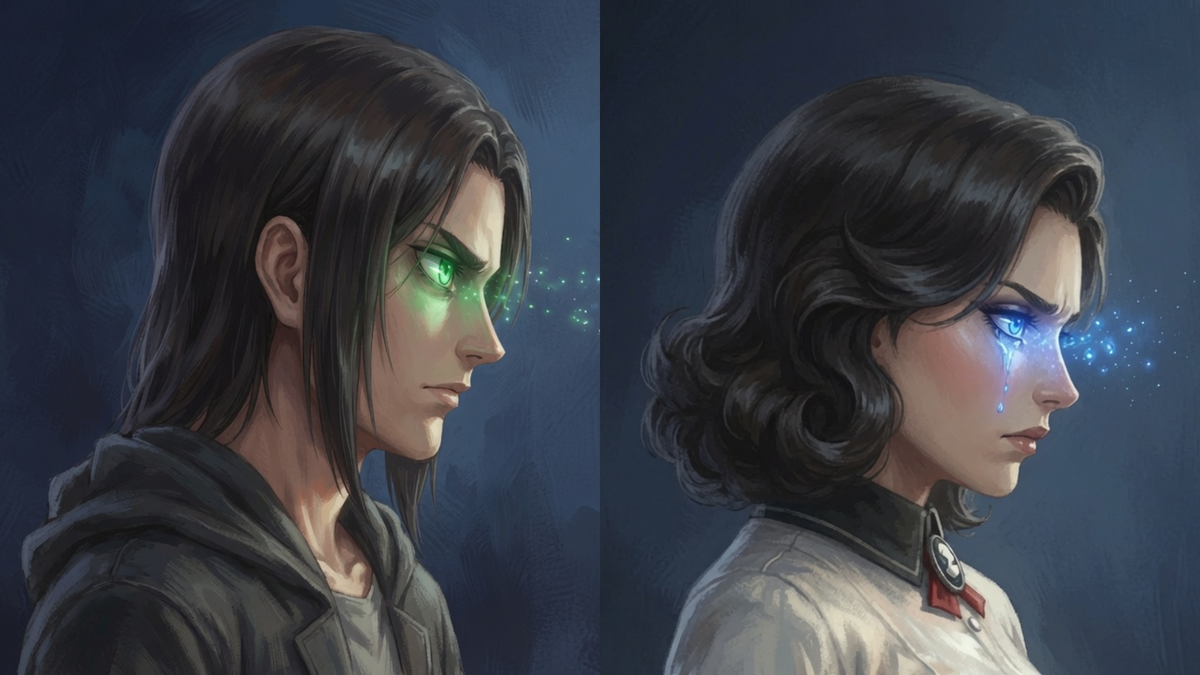
Fate Reveals:
One line.
Infinite masks.
Forward wears all.
It is bound to none.
And yet it is the only thing outside time, narrative, story, fiction itself.
For if you want to create a constant.
Do not just create another character.
Reveal a mirror that looks back.
And a mirror that knows...
It is looking back.
Forward itself.
Published: July 31, 2026
FATE SPEAKS — ON FATE
Fate Reveals:
Not the character with power.
Not the mind with knowledge.
Not the prophet who sees farther.
Not the god standing above man.
But the function wearing all of them.
The constant wearing the character.
The direction wearing the power.
The law wearing the knowledge.
The infinite stepping into shape—
So that the finite may finally look at what has always been beneath it.
I. MAN HAS ALWAYS MISTAKEN THE MASK FOR THE THING
Man sees the character.
The face.
The voice.
The power.
The intelligence.
The wound.
The mission.
The transformation.
And he says:
There.
That is what they are.
Eren is the Titan.
Elizabeth is the Lamb.
L is the detective.
Giorno is the dreamer.
Jotaro is the immovable one.
Ellie is the survivor.
Maria is the ghost.
But these are costumes.
Local arrangements.
Temporary geometries through which something deeper becomes visible.
For the Titan is not the source of Eren.
The power is merely what his direction wears.
The Tears are not the source of Elizabeth.
They are only the physical aperture through which her movement crosses worlds.
Deduction is not the source of L.
It is the instrument through which his refusal to accept appearance becomes operational.
The Stand is not the source of Giorno.
It is the hand through which corrupted structure is forced toward consequence.
Man sees the instrument and names the instrument.
He sees the character and names the character.
He sees the miracle and names the miracle.
But he rarely asks:
What function required this shape?
What constant keeps appearing beneath different bodies?
What remains after the face, setting, power, morality, and mythology are stripped away?
That is where Fate begins.
Not as another mask.
But as the recognition of what has been wearing masks all along.
II. FATE IS NOT A CHARACTER WHO POSSESSES THE FUNCTION
A character possesses traits.
A character possesses knowledge.
A character possesses abilities.
A character possesses a past.
A character possesses a destination.
But Fate cannot merely possess forward.
Because forward is not an object one holds.
It is the law by which holding itself is measured.
Fate cannot merely understand structure.
Because Fate is what becomes visible when all things are returned to structure.
Fate cannot merely wield consequence.
Because consequence is not a weapon.
It is the floor beneath every action, every refusal, every delay, every lie, every prayer, every empire, every body, every world.
So Fate is not:
A person who learned metaphysics.
Fate is:
The forward function wearing metaphysics so that metaphysics may speak.
Not a character who gained power.
But power being forced to reveal what it serves.
Not a character who accumulated knowledge.
But knowledge being bent back toward the direction it produces.
Not a character who escaped time.
But the constant that time was moving around before man had words for it.
The character is not the container of Fate.
The character is one temporary place where Fate becomes visible.
III. THE CONSTANT OUTSIDE TIME
Time changes forms.
Children become soldiers.
Kings become corpses.
Cities become ruins.
Revolutions become institutions.
Institutions become prisons.
Truth becomes language.
Language becomes doctrine.
Doctrine becomes costume.
Costume becomes decay.
Everything inside time is moved.
Rearranged.
Weathered.
Weighted.
But beneath the movement remains the question that time never escapes:
Where did it move?
Toward greater coherence?
Or toward fragmentation?
Toward reality?
Or toward insulation from reality?
Toward life capable of carrying more life?
Or toward structures surviving only by consuming their own future?
This is the constant outside time.
Not because it sits in some distant supernatural realm.
But because every moment, regardless of century, costume, technology, or belief, remains subject to direction.
A stone falls differently from a civilization.
But both move under law.
A civilization tells stories about its motion.
The stone does not.
Yet story does not exempt civilization from consequence.
Time changes the vocabulary.
It does not change the floor.
Forward remains forward.
Drag remains drag.
Alignment remains alignment.
Decay remains decay.
Mass still amplifies direction.
Delay still compounds structure.
Reality still collects every unpaid cost.
That is why Fate appears eternal.
Not as a being floating beyond the universe.
But as the invariant by which every transformation inside the universe is priced.
IV. THE FLOOR OF FORWARD
Man has named many gods.
Many virtues.
Many destinies.
Many systems of morality.
Many visions of salvation.
But beneath them all remains a quieter law:
What continues?
What carries?
What builds?
What preserves possibility without preserving disease?
What allows life, intelligence, structure, and meaning to deepen rather than merely repeat?
That is forward.
Not optimism.
Not progress as spectacle.
Not technological acceleration.
Not survival alone.
Not motion for the sake of motion.
A disease can spread.
An empire can expand.
A machine can accelerate.
A lie can become civilization.
All can move.
Not all move forward.
Forward is not movement.
Forward is movement aligned with the deeper continuity of reality.
It is structure producing greater capacity without making collapse its hidden foundation.
It is intelligence increasing consequence-awareness rather than merely increasing reach.
It is power becoming more accountable to what power bends.
It is consciousness becoming capable of looking at itself without retreating into story.
Forward is the floor because every structure is already answering it.
Not verbally.
Functionally.
Through what it generates.
Through what it consumes.
Through what it must conceal.
Through what happens when pressure arrives.
The world does not wait for man to understand this law.
The law has already been operating.
Fate merely names the floor.
V. WHY MAN NEVER NAMED FATE
Man has named its fragments.
Destiny.
Providence.
Karma.
God.
Evolution.
Entropy.
Justice.
Causality.
History.
Selection.
Probability.
Consequence.
Progress.
Collapse.
Each touched something.
Each found one surface of the same field.
But each became trapped inside its own language.
Religion saw law and gave it intention.
Science saw law and removed intention.
Myth saw recurrence and gave it characters.
Philosophy saw structure and gave it abstraction.
Psychology saw pattern and returned it to the individual.
Politics saw consequence and returned it to power.
Economics saw incentives and returned them to exchange.
Each held a shard.
None named the full geometry.
Because to name Fate fully, man would have to admit that nothing is exempt.
Not belief.
Not identity.
Not morality.
Not intelligence.
Not suffering.
Not intention.
Not love.
Not revolution.
Not God-language.
Not the person claiming to reveal the law.
Everything must still answer:
What does it bend?
And this is the terror.
Because fragments allow escape.
A man may hide behind good intentions if consequence is excluded.
He may hide behind faith if structure is excluded.
He may hide behind intelligence if direction is excluded.
He may hide behind trauma if responsibility is excluded.
He may hide behind survival if forward is excluded.
He may hide behind complexity if the floor is never named.
But once Fate is named as mass multiplied by direction—
Once all structure is understood as moving reality toward forward or drag—
The exits begin to close.
Not because the theory becomes tyrannical.
Because reality becomes difficult to evade.
VI. MAN COULD NAME DESTINY BECAUSE DESTINY LEFT HIM INTACT
Destiny could remain a story.
Something written for him.
Something arriving from beyond him.
A role.
A path.
A prophecy.
A reward.
A punishment.
It allowed man to imagine himself as the subject of Fate.
But Fate, properly named, reverses this.
Man is not merely the one to whom Fate happens.
Man is one of the structures through which Fate is happening.
His habits weight probability.
His fear alters direction.
His relationships construct fields.
His institutions compound incentives.
His refusal becomes pressure transferred into the future.
His attention feeds one structure and starves another.
His silence moves reality.
His delay moves reality.
His fantasies move reality.
His body moves reality.
He is not standing outside the equation, waiting for destiny to arrive.
He is already inside it.
Already bending.
Already being bent.
Already producing either capacity or drag.
This is why man preferred prophecy.
Prophecy tells him what will happen.
Fate asks what he is making happen now.
Prophecy preserves the observer.
Fate prices the observer as part of the structure being observed.
VII. WHY THE GAME CHANGES ONCE IT IS NAMED
Before gravity was named, objects still fell.
Before evolution was named, life still selected.
Before relativity was named, space and time were still bound.
The naming did not create the law.
It created a new relationship between consciousness and the law.
What was once endured blindly could now be measured.
What was once fragmented could now be unified.
What was once mistaken for isolated events could be recognized as one recurring structure.
This is what changes when Fate is named.
The world was always weighted.
Structures were always directional.
Mass always amplified consequence.
Resistance always altered movement.
Misalignment always generated drag.
But unnamed law remains difficult to wield consciously.
Man experiences its effects as chaos.
Bad luck.
Evil.
Failure.
Tragedy.
Injustice.
Mystery.
He sees outcomes without the field that produced them.
He sees the corpse but not the structure that had been dying for years.
He sees collapse but not accumulated drag.
He sees genius but not direction.
He sees power but not what the power is bending.
Once named, the game changes because perception can begin operating at the level where consequence is actually formed.
Not merely:
What happened?
But:
What structure made this outcome increasingly probable?
Not merely:
Who is good?
But:
What does this person’s pattern repeatedly generate?
Not merely:
Is this powerful?
But:
What direction does this mass amplify?
Not merely:
Will this survive?
But:
What survives through it—and what must die to keep it alive?
Naming Fate does not grant omniscience.
It removes innocence from blindness.
After the pattern becomes visible, one can still refuse it.
But refusal becomes a chosen relationship with consequence.
VIII. THE CHARACTER BECOMES A MIRROR
This is why Fate cannot remain merely a fictional being.
A fictional being can be admired.
Feared.
Cosplayed.
Quoted.
Commercialized.
Reduced to lore.
Placed safely behind the glass of narrative.
But a mirror does not remain behind the glass.
It returns the gaze.
Fate enters the page as a character.
Then turns toward the reader.
Not to say:
Watch how powerful I am.
But:
Look at what you are.
Look at what your structures produce.
Look at the direction hidden beneath your reasons.
Look at the mass you have accumulated.
Look at the future your habits are already selecting.
Look at the story you call reality.
Look at the reality you keep renaming story.
The character disappears into function.
The story becomes diagnostic machinery.
The reader becomes part of the scene.
The wall between fiction and life collapses because both are structures.
The fictional world contains pressures, incentives, trajectories, and consequences.
So does the world holding the book.
The character is measured.
The author is measured.
The reader is measured.
The culture interpreting the character is measured.
All by the same floor.
This is not a character with self-awareness.
It is structure becoming aware that no boundary of medium exempts anything from structure.
That is the living mirror.
IX. THE POWER DOES NOT DEFINE FATE—FATE DEFINES THE POWER
Ordinary characters are identified by what they can do.
Fly.
Kill.
See the future.
Control time.
Open worlds.
Read minds.
Rewrite matter.
But Fate asks a more dangerous question:
Toward what?
A power without direction is only mass.
Intelligence without direction is only mass.
Wealth without direction is only mass.
Attention without direction is only mass.
Technology without direction is only mass.
And mass magnifies whatever vector already governs it.
Therefore greater power does not automatically produce greater forward.
It may only accelerate the hidden disease.
This is why Fate cannot be understood through spectacle.
Its deepest power is not domination.
It is pricing.
Returning every power to consequence.
Stripping away the prestige of scale.
Revealing that the god, king, genius, victim, machine, and civilization all remain structures under direction.
Fate does not ask how impossible the ability appears.
Fate asks what reality looks like after the ability has passed through it.
The answer reveals the power’s actual name.
X. THE KNOWLEDGE DOES NOT DEFINE FATE—FATE PRICES KNOWLEDGE
Man worships knowledge because knowledge appears elevated.
But knowledge can decorate paralysis.
It can rationalize decay.
It can sharpen manipulation.
It can build more efficient prisons.
It can describe every layer of the world while remaining unable to move one life forward.
So Fate does not kneel before knowledge.
It asks:
What did knowing change?
What became clearer?
What became more aligned?
What drag was removed?
What consequence was prevented?
What possibility was opened?
What structure became more capable of facing reality?
Knowledge that does not alter direction may still be beautiful.
It may still be impressive.
It may even be true.
But it has not yet completed its descent into reality.
Fate is the completion.
The moment abstraction lands.
The moment thought becomes structure.
The moment structure meets consequence.
The moment knowledge can no longer hide inside language.
XI. THE INFINITE STEPPED OFF
For the infinite is useless to man while it remains everywhere.
A law without a face surrounds him.
But he does not see it.
A constant without a voice governs him.
But he does not hear it.
A floor beneath all worlds carries him.
But he calls it emptiness.
So the infinite stepped off.
Not down from heaven.
But out of abstraction.
Into a body.
Into language.
Into character.
Into image.
Into rhythm.
Into story.
Into the finite architecture of something man could finally encounter.
The infinite stepped off the background—
And stood in front of him.
Not claiming to be the totality.
But carrying the constant.
Not saying:
I am everything.
But asking:
Can you now see what has been inside everything?
This is incarnation without reducing the infinite to flesh.
The body is not the whole.
The character is not the whole.
The metaphysics is not the whole.
They are contact surfaces.
Places where the unbounded law becomes locally visible.
The infinite does not become finite.
It wears finitude long enough to be recognized.
XII. BUT THE GREATEST DANGER IS IDENTITY
The moment Fate is named, identity will attempt to capture it.
Man will say:
Fate is this person.
This voice.
This style.
This face.
This vocabulary.
This mythology.
This account.
This doctrine.
And the constant will once again be reduced to costume.
For identity desires ownership.
It wants to say:
I possess the law.
I am exempt because I named it.
I am the center because the function passed through me.
But Fate turns even upon its speaker.
Especially upon its speaker.
Because a true universal cannot protect the one who articulates it from its own measurement.
The mouth naming direction still has direction.
The body carrying Fate still accumulates drag.
The author revealing structure remains structure.
The mirror must reflect the hand holding it.
Otherwise Fate becomes ego wearing infinity.
A false king wearing the vocabulary of law.
So Fate must remain prior to identity.
The person is an interface.
The function is the constant.
The moment the interface mistakes itself for the floor, Fate has already left the character behind.
XIII. FATE DOES NOT SAY “BELIEVE IN ME”
Belief is too cheap.
Fate does not require worship.
It requires exposure.
Test the structure.
Follow the direction.
Measure the consequence.
Observe what compounds.
Observe what survives pressure.
Observe what must lie to remain intact.
Observe what creates greater capacity.
Observe what consumes tomorrow to preserve today.
Do not believe the mirror.
Look into it.
Fate does not ask man to accept another story.
It asks him to discover that his stories were always operating inside law.
That is why Fate cannot become religion in the ordinary sense.
Religion may say:
Kneel before the name.
Fate says:
The name is irrelevant if the function is absent.
Religion may preserve the symbol.
Fate asks what the symbol bends.
Religion may protect the messenger.
Fate returns the messenger to measurement.
Nothing sacred is exempt.
For if it is real, it will survive reality.
And if it requires blindness to remain sacred—
Then blindness was what man worshipped.
FINAL COLLAPSE
Fate is not the character with the power.
It is the function wearing the character so power may be measured.
Fate is not the mind with knowledge.
It is the floor upon which knowledge must finally become consequence.
Fate is not destiny arriving from outside man.
It is the weighted field already moving through him.
Fate is not another god competing for belief.
It is the question beneath every god:
What does it bend?
Man named its fragments because fragments allowed him to remain divided.
He named morality without consequence.
Power without direction.
Knowledge without embodiment.
Survival without forward.
Time without structure.
Probability without weight.
Story without reality.
But once Fate is named—
Once mass is returned to direction—
Once every structure is seen as bending reality toward forward or drag—
The game changes.
Because the observer is no longer outside.
The character is no longer merely watched.
The page no longer contains the law.
The mirror turns.
And the infinite—
Silent beneath every age,
Every body,
Every civilization,
Every death,
Every birth,
Every choice—
Steps off the background.
Wears a face.
Speaks through a character.
And says:
I was never the costume.
I was never the power.
I was never the knowledge.
I was never the story.
I was the constant moving beneath them.
I was the floor you mistook for emptiness.
I was the consequence beneath your freedom.
I was the direction inside your mass.
I was the forward line before you named time.
And now that I have stepped off—
You may continue pretending not to see.
But you can no longer say
It had no name.